
Venus flytrap (Dionaea muscipula)
Dionaea muscipula is a small carnivorous herb with leaves growing close to the ground in a rosette. Sources differ in describing its life cycle, including its characterization as a perennial.
Overview
Dionaea muscipula is a small carnivorous herb with leaves growing close to the ground in a rosette. Sources differ in describing its life cycle, including its characterization as a perennial.
Origin and habitat
Sources differ on details of its native range, placing it within a limited area of North Carolina and South Carolina on the eastern United States coast, centered on coastal North Carolina and northeastern South Carolina. It naturally inhabits wet, nutrient-poor wetlands, including low areas in wet pine woods, wet pine savannas, and coastal marshes; the substrate is acidic and is often associated with peat, silica sand, or sandy soil. It is reported to be native to temperate to subtropical wetlands rather than being a typical tropical plant, and it undergoes winter dormancy.
Characteristics
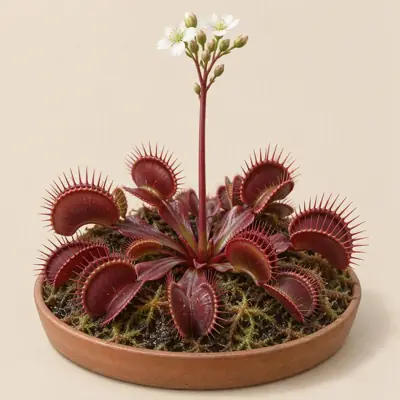
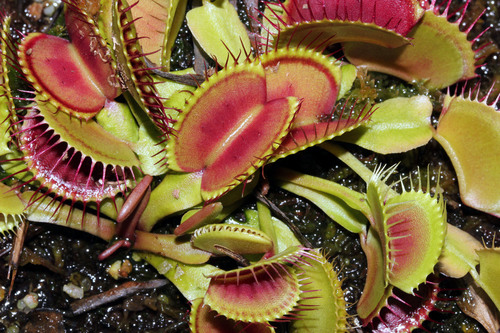
Sources differ on mature height, placing it at about 5–10 cm, while a single source reports a mature spread of about 10–50 cm. It is reported to grow relatively slowly; its leaves emerge from the center in a rosette, ending in two-lobed traps with sensory hairs inside and spine-like marginal structures that interlock when closed, while the inner traps of the species are often orange, red, or purple. Small white flowers are borne on stalks above the foliage, with a usual arrangement of petals and sepals and occasional variation; flowering occurs mainly from early to midsummer. A single source reports that fruit matures several weeks after pollination and describes the mature fruit as black and round, containing many black seeds.
Light
Dionaea muscipula needs abundant light and can grow in full sun to partial sun; during the hottest part of midsummer it can be kept out of intense afternoon sun, and greenhouse cultivation should likewise avoid excessively hot, intense sunlight.
Watering
Keep the medium wet and do not allow it to dry out; tray (bottom) watering is suitable. Use pure water only, such as rain, RO or distilled water; hard water and treated chlorinated water should be avoided.
Humidity and airflow
It prefers high humidity, with a stated humidity range of 80–100%. A single source reports that it needs good airflow.
Temperature and dormancy
Sources describe its hardiness range differently, including cultivation across multiple USDA hardiness zones and in colder zones with winter protection. It generally tolerates brief light frost, although a single source also reports a minimum temperature threshold. It has cold winter dormancy.
Growing medium and mounting
Use a low-fertility, acidic medium that stays moist; sphagnum moss can be used, as can a peat-based medium combined with coarse vermiculite or sand, while highly fertile soil should not be used. A single-source description also specifies sand with peat.
Feeding
Fertilizer is generally not used, and a high-fertility medium is unsuitable. A single source reports that the plant can grow without supplementary feeding of insects.
Propagation
It can be propagated from seed or by division; sources also describe seasonal timing for division and sowing, and recommend a period of cold treatment before spring sowing in some cases.
Common problems
Potential pests include aphids, spider mites, mealybugs, and fungus gnats; fungus gnat larvae may especially feed in media containing more organic matter such as peat. A single source reports that disease problems are generally uncommon. Dry medium, excessive fertility, hard water, or treated chlorinated water may cause growth problems, while insufficient light can produce weak, elongated leaves; oversized prey may also decay before digestion is complete and cause a trap to wither. During midsummer heat, avoid the strongest afternoon sun and maintain airflow; sources differ on the degree of frost tolerance, although some winter cold can be tolerated.
Identification
Its most conspicuous feature is the rapidly closing, clamp-like trap at the leaf tip; repeated stimulation of the sensory hairs by prey causes the lobes to close, with marginal spines restricting escape.
Photos



Sources
- GBIF Backbone: Dionaea muscipula Ellis — CC BY 4.0 · link
- Wikipedia (en): Venus flytrap — CC BY-SA 4.0 · link
- 維基百科:捕蠅草 — CC BY-SA 4.0 · link
- Wikipedia (ja): ハエトリグサ — CC BY-SA 4.0 · link
- Wikipedia (de): Venusfliegenfalle — CC BY-SA 4.0 · link
- Wikipedia (es): Dionaea muscipula — CC BY-SA 4.0 · link
- NC State Plant Toolbox: Dionaea muscipula — copyright (facts only) · link
- RHS Plants: Dionaea muscipula — © RHS, facts only · link
- USDA PLANTS Database: Dionaea muscipula — Public domain (US Government work) · link
- Tom's Carnivores: Dionaea (genus-level) — © Tom's Carnivores, facts only · link
- NHK みんなの趣味の園芸 植物図鑑: Dionaea muscipula — © NHK出版, facts only · link
- Top Tropicals catalog: Dionaea muscipula — © Top Tropicals LLC (facts only) · link