
Venus flytrap (Dionaea muscipula)
Dionaea muscipula is a low-growing, rosette-forming perennial carnivorous herb with a short stem or underground rhizome. Sources differ in describing its life cycle, including its characterization as perennial.
Overview
Dionaea muscipula is a low-growing, rosette-forming perennial carnivorous herb with a short stem or underground rhizome. Sources differ in describing its life cycle, including its characterization as perennial.
Origin and habitat
Sources differ somewhat on its native range, placing it on the eastern coast of the United States in North Carolina and South Carolina, mainly in a restricted area of coastal North Carolina and northeastern South Carolina. It inhabits wet, nutrient-poor coastal wetlands, wet pine flats, wet pine savannas, and similar boggy environments, often with acidic, sandy, or peaty substrates. It is native to temperate to subtropical wetlands of the southeastern United States, where winters are seasonally cool.
Characteristics
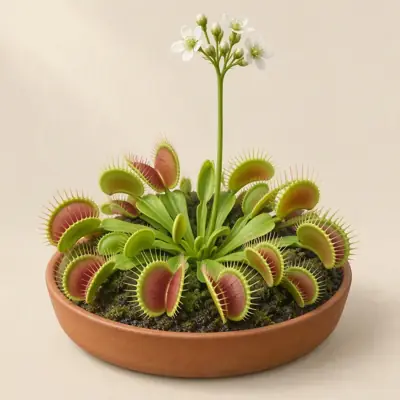
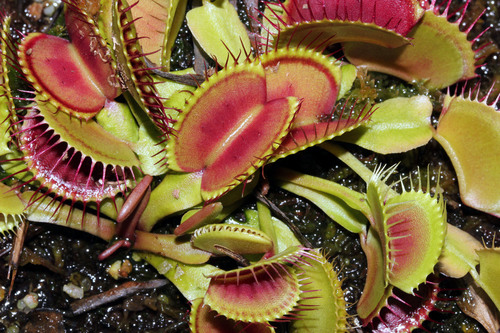
Sources differ on mature height, with the few available estimates placing it at about 5–10 cm; mature spread is 10–50 cm. Leaves form a central rosette, with flattened petioles ending in traps made of rapidly closing lobes; sources differ in their descriptions, but trap interiors are often red, orange, or purple, with tooth-like marginal bristles, sensory hairs, and digestive glands inside. White flowers are borne in clusters on stalks above the leaves, with petals and sepals, and flowering occurs mainly from late spring through summer. After successful pollination, the ovary is reported to enlarge and later mature into a black, round fruit containing black seeds; growth is relatively slow and maturity sufficient for flowering usually takes years.
Light
Dionaea muscipula grows in full sun to partial sun and should receive ample light in cultivation, while the strongest afternoon sun can be avoided during very hot summer conditions.
Watering
Keep the medium continuously wet, using direct watering or tray (bottom) watering. Use pure water only (rain, RO or distilled); hard water and treated chlorinated water should be avoided. A single source reports a summer watering interval of about 1, so evidence for this figure is limited.
Humidity and airflow
It prefers high humidity, with a stated humidity range of 80–100 %. It is generally reported to need good airflow.
Temperature and dormancy
It is described for a range of USDA hardiness zones, with cultivation in colder zones possible when protected in winter. A single source gives an ideal temperature range of about 25–30 °C, so evidence for this range is limited. Sources differ regarding its minimum-temperature tolerance, while it is described as tolerating brief light frost. Dionaea muscipula has cold winter dormancy.
Growing medium and mounting
Use a nutrient-poor, acidic medium that retains moisture; suggested materials include sphagnum moss, peat-based media combined with coarse sand or vermiculite, and other nutrient-poor mixes.
Feeding
Fertilizer is generally avoided, as are nutrient-rich growing media. A single source reports that the plant can grow without being fed insects.
Propagation
Dionaea muscipula can be propagated from seed or by division.
Common problems
Potential pests include aphids, spider mites, mealybugs, and fungus gnats, while disease is generally reported to be uncommon. Allowing the medium to dry, using hard or treated chlorinated water, or providing excessive winter moisture can cause problems, with excessive winter moisture increasing the risk of root rot; prey that is too large can decay before digestion is complete and cause the trap leaf to wither. It can withstand some winter cold, while excessive exposure during hot summer conditions should be avoided and airflow maintained; sources differ on its tolerance of frost.
Identification
Its most distinctive feature is the modified leaf ending in a jaw-like trap; repeated stimulation of sensory hairs within a short period can trigger the lobes to close rapidly, while the marginal bristles interlock and restrict the prey's escape.
Photos



Sources
- GBIF Backbone: Dionaea muscipula Ellis — CC BY 4.0 · link
- Wikipedia (en): Venus flytrap — CC BY-SA 4.0 · link
- 維基百科:捕蠅草 — CC BY-SA 4.0 · link
- Wikipedia (ja): ハエトリグサ — CC BY-SA 4.0 · link
- Wikipedia (de): Venusfliegenfalle — CC BY-SA 4.0 · link
- Wikipedia (fr): Dionée attrape-mouche — CC BY-SA 4.0 · link
- Wikipedia (es): Dionaea muscipula — CC BY-SA 4.0 · link
- NC State Plant Toolbox: Dionaea muscipula — copyright (facts only) · link
- RHS Plants: Dionaea muscipula — © RHS, facts only · link
- USDA PLANTS Database: Dionaea muscipula — Public domain (US Government work) · link
- Tom's Carnivores: Dionaea (genus-level) — © Tom's Carnivores, facts only · link
- NHK みんなの趣味の園芸 植物図鑑: Dionaea muscipula — © NHK出版, facts only · link
- Top Tropicals catalog: Dionaea muscipula — © Top Tropicals LLC (facts only) · link
- 捕蠅草不只一種?6 品系熱門捕蠅草照顧全指南 - 微體溫室 Micro Oasis (micro-oasis.com) — facts only (§12) · link