
longan (Dimocarpus longan)
Dimocarpus longan is an evergreen, much-branched tree that can be cultivated as a fruit tree. It is reported to be perennial.
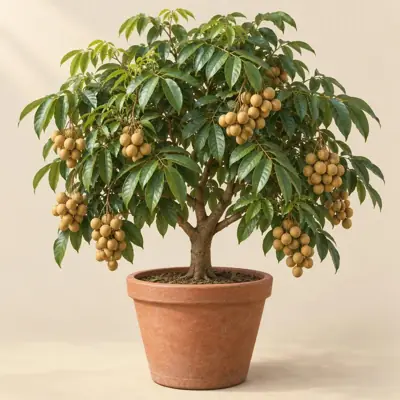
Overview
Dimocarpus longan is an evergreen, much-branched tree that can be cultivated as a fruit tree. It is reported to be perennial.
Origin and habitat
Sources differ on its native range, describing it as extending from southern China into Southeast Asia. It is reported from moist mountain woodland, the understory of primary forest, and secondary vegetation, and is also widely cultivated. It is suited to warm subtropical to tropical or frost-free warm-temperate climates, favoring warm, humid conditions; flowering generally requires a cooler, nearly frost-free period, and the plant is sensitive to frost and low temperatures.
Characteristics
Sources differ on mature height, giving a range of about 900–1400 cm. It is reported to grow rapidly. Sources differ in descriptions of the foliage: the evergreen pinnate compound leaves are alternate, with dark green, glossy surfaces and somewhat leathery leaflets. It is reported to have small yellowish-white to pale yellow flowers in branched panicles at branch tips or leaf axils, with flowers of different functional sexes occurring within the same inflorescence; flowering is reported from spring to early summer, and the nearly spherical fruits occur in clusters, with pale brown to yellowish-brown skin, white to translucent juicy flesh, and a large, hard, dark brown to black seed.
Light
It is reported to require abundant sunlight and light.
Watering
It is reported to require ample soil moisture from fruit development through ripening.
Temperature and dormancy
Sources differ, but a lower temperature of about -2 °C is reported. With few sources available, an ideal temperature range of about 18–30 °C is reported. With few sources available, a maximum temperature of about 36 °C is reported.
Growing medium and mounting
It is reported to tolerate various soils, with a preference for sandy soil and better growth in well-drained, deep sandy loam.
Common problems
It is reported that flowering may be poor after warm winters or where there is no distinct cool season, while fruiting may also be poor in low-elevation tropical areas where the cool season is insufficient. It is reported to be sensitive to frost and low temperatures and to prefer environments where temperatures generally remain relatively warm, although brief colder conditions have also been reported.
Identification
It is reported that beneath the fruit skin, translucent flesh surrounds a large black seed with a white spot at its base, creating an eye-like appearance associated with the name “dragon's eye.”
Photos


Sources
- Wikipedia (en): Longan — CC BY-SA 4.0 · link
- 維基百科:龙眼 — CC BY-SA 4.0 · link
- Wikipedia (ja): リュウガン — CC BY-SA 4.0 · link
- Wikipedia (de): Longan — CC BY-SA 4.0 · link
- Wikipedia (fr): Longane — CC BY-SA 4.0 · link
- Wikipedia (es): Dimocarpus longan — CC BY-SA 4.0 · link
- TaiCOL 臺灣物種名錄: Dimocarpus longan — CC BY 4.0 · link
- Useful Tropical/Temperate Plants: Dimocarpus longan — CC BY-NC-SA 3.0 (facts only) · link
- USDA PLANTS Database: Dimocarpus longan — Public domain (US Government work) · link