
dumbcane (Dieffenbachia seguine)
Dieffenbachia seguine is an evergreen perennial herb with an upright, sparsely branched habit; mature plants may become shrubby, with fleshy, jointed, cane-like stems.
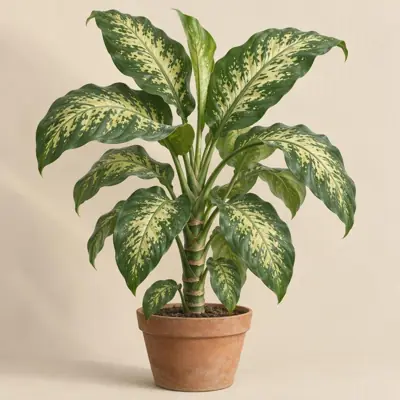
Overview
Dieffenbachia seguine is an evergreen perennial herb with an upright, sparsely branched habit; mature plants may become shrubby, with fleshy, jointed, cane-like stems.
Origin and habitat
Sources differ on its native range, describing it broadly as Neotropical, from southern Mexico, Belize, and Central America through the Caribbean islands to northern and tropical South America, including Colombia, Venezuela, Guyana, Suriname, French Guiana, Ecuador, Bolivia, and Brazil. It is reported from tropical American forest environments, with Dieffenbachia generally occurring in the filtered light of humid rainforest understories in the wild. Its climate is tropical, warm, and relatively humid.
Characteristics
Sources differ on mature height, placing it at about 100–400 cm, while mature spread is 50–91 cm. Growth is reported to be moderate; the large, simple leaves range from ovate to ovate-lanceolate, oblong, or lanceolate, are green to dark green and often glossy, and commonly show white, cream, yellow, or pale green mottling and markings. It forms the typical spadix and spathe inflorescence, which may be white to greenish white, and it rarely flowers indoors. A flowering period is reported, and fruiting is reported to be rare when grown as an indoor potted plant.
Light
Sources differ somewhat on light conditions: bright filtered light to partial shade is described as most suitable, and it tolerates low light, although prolonged dim conditions may produce weak growth; stronger sunlight may be acceptable in some outdoor conditions.
Watering
Water moderately during active growth, watering thoroughly after the surface of the growing medium dries and avoiding prolonged waterlogging; reduce watering in winter and keep it somewhat drier.
Humidity and airflow
Dieffenbachia seguine prefers high humidity.
Temperature and dormancy
A single source reports a minimum temperature of about 4.4 °C, so sources are few for this figure. Sources differ in their hardiness descriptions. It is generally described as frost tender; keep above freezing.
Growing medium and mounting
Use a well-drained, fertile, humus-rich growing medium; loamy or sandy soil can be used, and a broad range of soil acidity and alkalinity is tolerated. An airy mix is suitable.
Feeding
Sources differ on feeding schedules, but regular feeding during the growing season is recommended, with one source advising balanced liquid fertilizer and another advising slow-release fertilizer from spring through autumn.
Propagation
Propagation can be by stem-tip cuttings, bud-bearing stem-section cuttings, or air layering, while young Dieffenbachia plants can also be divided; stem sections can be laid horizontally on the surface of the growing medium and kept warm.
Common problems
Possible pests include scale insects, aphids, spider mites, whiteflies, and fungus gnats. Sources differ in their disease listings, which include leaf spot, root rot, blight, anthracnose, and stem rot. Prolonged insufficient light can cause weak growth; as plants age, lower old leaves may fall, and increasing foliage at the top can make plants top-heavy, causing stems to bend or plants to topple. It is sensitive to low temperatures, cold drafts, and frost, and cold injury can cause yellowing leaves, water-soaked patches, and wilting even when temperatures remain above freezing.
Identification
Upright fleshy stems and large variegated leaves, commonly marked with white, cream, yellow, or pale green patches, are key ornamental features.
Photos


Sources
- Wikipedia (en): Dieffenbachia seguine — CC BY-SA 4.0 · link
- 維基百科:花叶万年青 — CC BY-SA 4.0 · link
- Wikipedia (de): Dieffenbachie — CC BY-SA 4.0 · link
- Wikipedia (fr): Dieffenbachia seguine — CC BY-SA 4.0 · link
- Wikipedia (es): Dieffenbachia seguine — CC BY-SA 4.0 · link
- GBIF descriptions: Checklist of aquatic and marshy Monocotyledons from the Araguaia River basin, Brazilian Cerrado; Cat — per dataset · link
- NC State Plant Toolbox: Dieffenbachia seguine — copyright (facts only) · link
- RHS Plants: Dieffenbachia seguine — © RHS, facts only · link
- USDA PLANTS Database: Dieffenbachia seguine — Public domain (US Government work) · link
- NHK みんなの趣味の園芸 植物図鑑: Dieffenbachia seguine — © NHK出版, facts only · link
- Top Tropicals catalog: Dieffenbachia seguine — © Top Tropicals LLC (facts only) · link
- dumb cane - KPU Plant DB (plantdatabase.kpu.ca) — facts only (§12) · link
- Dieffenbachia Plant Care (Dumb Cane) | Almanac.com (www.almanac.com) — facts only (§12) · link
- My dieffenbachia is so tall it’s touching the ceiling. How caMy dieffenbachia is (neilsperry.com) — facts only (§12) · link