
annual pink (Dianthus chinensis)
Dianthus chinensis is a herbaceous plant with a branching, clump-forming habit. Sources differ in describing its life cycle: it is a perennial herb, while in horticultural cultivation it is often grown as an annual or biennial.
Overview
Dianthus chinensis is a herbaceous plant with a branching, clump-forming habit. Sources differ in describing its life cycle: it is a perennial herb, while in horticultural cultivation it is often grown as an annual or biennial.
Origin and habitat
Sources differ somewhat on its native range, placing it in East Asia, mainly including China, Korea, Mongolia, and southeastern to Far Eastern Russia, with some also including Kazakhstan. It occurs in grasslands, grassy slopes, meadows, open woodland and forest margins, as well as shrubland, rocky valleys and areas near streams. It is widely cultivated in temperate regions and favors warm conditions, but performs less well in hot conditions.
Characteristics
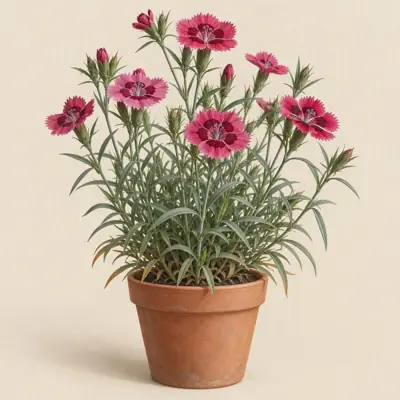
Sources differ and are few on mature height, reporting about 30–50 cm. The leaves are narrow and elongated, linear to linear-lanceolate, green to gray-green, and opposite; basal leaves may have withered by flowering time. Sources differ somewhat on flower color, describing white, pink, deep pink, red to dark red, with purple also reported; the petals have toothed or fringed notches and often darker central markings, and flowers may occur singly, in pairs or in small cymes, with horticultural varieties potentially bearing more flowers per inflorescence. Flowering is mainly from spring through summer and can continue into autumn under cultivation, with better performance in spring and autumn in Taiwan; the fruit is reported to be a capsule enclosed by the sepals that splits by teeth when mature, with black, flat, nearly round seeds.
Light
A position with abundant sunlight and good ventilation is preferred, while afternoon shade can be provided in warmer regions.
Watering
Keep the growing medium dry to moderately moist and avoid waterlogging, as poor drainage readily leads to crown rot.
Humidity and airflow
Dianthus chinensis is reported to need good airflow.
Temperature and dormancy
A single source reports an ideal temperature range of about 12–27 °C, so sources are few.
Growing medium and mounting
Well-drained sandy loam or loam is preferred, and the plant can adapt to dry soil; Useful Temperate Plants additionally describes a preference for fertile, well-drained, neutral to alkaline loam.
Feeding
The plant is reported to have low nutrient requirements, with flower fertilizer applied periodically during cultivation.
Propagation
It is reported to be propagated mainly by seed, though cuttings can also be used; sowing is suitable from autumn and winter into early spring, while vigorous side shoots can be used as cuttings and managed away from strong light while rooting.
Common problems
When grown in excessively shaded conditions, Dianthus chinensis is reported to be vulnerable to damage from slugs and snails. Poor drainage is reported to favor crown rot, and rust may also occur. It performs poorly during hot, humid summers; poor drainage increases the risk of rot and disease, while excessive shade can increase problems with slugs and snails. It does not tolerate extreme heat well; in Taiwan, excessive heat or cold can impair growth, with hot, humid summers being particularly unfavorable.
Identification
Dianthus chinensis can be distinguished by its narrow, gray-green opposite leaves, clump-forming and branching habit, flowers with conspicuously toothed or fringed notches and often dark centers, and pointed bracts beneath the flowers.
Photos


Sources
- Wikipedia (en): Dianthus chinensis — CC BY-SA 4.0 · link
- 維基百科:石竹 — CC BY-SA 4.0 · link
- Wikipedia (ja): セキチク — CC BY-SA 4.0 · link
- Wikipedia (de): Chinesische Nelke — CC BY-SA 4.0 · link
- Wikipedia (es): Dianthus chinensis — CC BY-SA 4.0 · link
- GBIF descriptions: Database of Vascular Plants of Canada (VASCAN); DAISIE - Inventory of alien invasive species in Euro — per dataset · link
- NC State Plant Toolbox: Dianthus chinensis — copyright (facts only) · link
- 農業知識入口網 植物圖鑑: Dianthus chinensis — © MOA, facts only · link
- Useful Tropical/Temperate Plants: Dianthus chinensis — CC BY-NC-SA 3.0 (facts only) · link
- USDA PLANTS Database: Dianthus chinensis — Public domain (US Government work) · link