
Dendrobium hybrid (Dendrobium hybrid)
Dendrobium is reported to consist mostly of epiphytic or lithophytic sympodial herbaceous orchids, with some terrestrial species. It is reported to be perennial and herbaceous; some species are deciduous, and many alternate between periods of growth and dormancy.
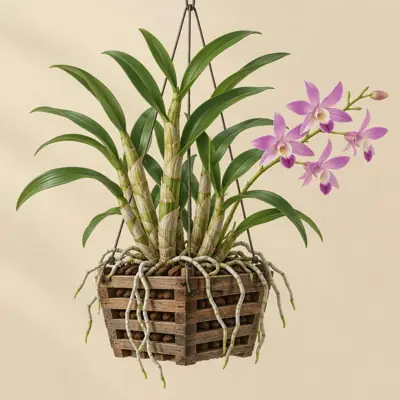
Overview
Dendrobium is reported to consist mostly of epiphytic or lithophytic sympodial herbaceous orchids, with some terrestrial species. It is reported to be perennial and herbaceous; some species are deciduous, and many alternate between periods of growth and dormancy.
Origin and habitat
Dendrobium is reported to be widespread from South, East, and Southeast Asia to Oceania, with records including India, China, Japan, the Philippines, Indonesia, Vietnam, Australia, New Guinea, New Zealand, New Caledonia, and Pacific islands. Reported habitats are highly diverse, ranging from high-elevation Himalayan environments and lowland tropical forests to Australian arid deserts; most species grow on trees or rocks, while some grow on the ground. The genus is reported from tropical and subtropical environments and includes warm-, intermediate-, and cool-growing groups.
Characteristics
Leaves are reported to vary from linear to oblong, with some nearly cylindrical, and are usually distinctly longer than wide; different groups may be evergreen or deciduous. Flowers are reported to occur along unbranched flower stalks or from stem nodes, either singly, in small clusters, or in racemes; colors include white, green, yellow, pink, and purple, often with a contrasting lip. Some species are reported to be fragrant, and flower longevity varies among groups.
Light
Dendrobium is generally grown in bright, indirect, or filtered light, though requirements differ among groups. Phalaenanthe and Spatulata are reported to tolerate stronger light, while Nobile-type and Latouria prefer filtered light; indoors, a bright east- or south-facing window may be suitable, and some species should avoid strong direct midday light. It is generally considered a medium-light plant.
Watering
During active growth, Dendrobium is generally watered thoroughly while keeping the medium moderately moist and allowing it to dry slightly between waterings, without remaining waterlogged. Groups with dormancy are generally given substantially less water after their canes mature; deciduous types may receive little or no water from late autumn into early winter, with normal watering resumed when new growth appears.
Humidity and airflow
Sources differ on humidity, giving an approximate range of 40–70 %. Dendrobium is generally reported to prefer high humidity and need good airflow.
Temperature and dormancy
Dendrobium is generally classified as intermediate in temperature requirements.
Growing medium and mounting
Dendrobium is reported to be epiphytic and generally prefers bark. For pots, a well-drained, well-aerated, bark-based orchid medium is generally recommended; greenhouse mixes may use medium to coarse bark with perlite and charcoal, while indoor mixes may use fine to medium bark with sphagnum moss to increase moisture retention.
Feeding
During growth, regular feeding with a diluted balanced fertilizer is generally recommended, and a higher-nitrogen formula may be used in spring and summer. Nobile-type plants are generally given less fertilizer in autumn to support flowering, while Latouria and Spatulata may receive light feeding throughout the year; occasional flushing with plain water is used to limit salt accumulation in the medium.
Propagation
When division is needed, divisions are generally kept large enough to reduce the impact on flowering.
Common problems
Mealybugs are reported as a possible pest. In high-humidity growing conditions, poor air circulation is reported to increase the likelihood of fungal or bacterial problems. Insufficient light may cause elongated growth or failure to flower, while excessive light may cause yellowing or scorching; excessive watering during dormancy, insufficient water during growth, and prolonged waterlogging may seriously damage plants. Temperature tolerance is reported to vary substantially among groups: warm-growing groups tolerate higher temperatures, while cooler-growing groups such as Nobile-type and Formosae prefer lower night temperatures in autumn, and a moderate day-night temperature difference is considered beneficial for growth and flowering.
Identification
Dendrobium is reported to commonly have narrow, elongated, jointed, cane-like pseudobulbs, with cylindrical roots usually emerging from their bases. Racemes may form from upper nodes of the pseudobulbs, or flowers may occur singly or in small clusters along cane nodes; a spur may be visible behind the flower.