
winter daphne (Daphne odora)
Daphne odora is a dense, evergreen woody shrub with a clumping or bushy habit. It is a woody perennial, but sources differ on whether individual plants may be relatively short-lived.
Overview
Daphne odora is a dense, evergreen woody shrub with a clumping or bushy habit. It is a woody perennial, but sources differ on whether individual plants may be relatively short-lived.
Origin and habitat
Southern China is described as the main native range, while some horticultural sources also include Vietnam and Taiwan; sources differ. It is reported to occur under the shade of trees in upland habitat. It is suited to sheltered positions and can grow in sun to partial sun, with limited tolerance of severe cold and exposed conditions.
Characteristics
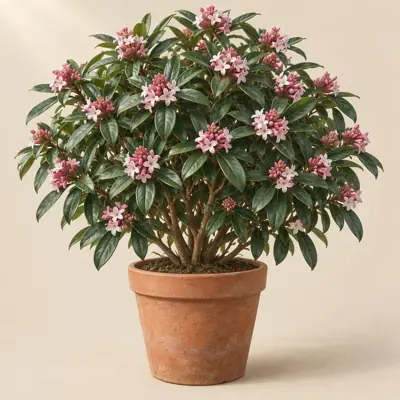
Sources differ on mature height, which is about 100–150 cm; a single source reports a mature spread of about 100–150 cm. It is reported to grow slowly, with evergreen, alternate leaves often crowded near the ends of branches; the leaves are dark green, glossy and leathery, ranging from oblanceolate to obovate or obovate-elliptic in shape. The highly fragrant flowers cluster at branch tips and lack true petals; their tubular calyx has spreading lobes, and colors range from white and pale pink to purplish red or deep pink, commonly with a pink to purplish-red exterior and white interior. Flowering occurs from late winter into spring; red, nearly spherical fruits can form, although sources differ and cultivated plants often fruit sparsely or rarely.
Light
Daphne odora grows in full sun to partial sun.
Watering
The soil should be moist but well drained; it may be allowed to dry slightly between waterings, while prolonged waterlogging should be avoided.
Temperature and dormancy
A single source gives a minimum temperature of about -5 °C, but sources differ.
Growing medium and mounting
Fertile, loose, well-drained soil is suitable, and waterlogged roots are unfavorable; sources differ in their descriptions of suitable soil pH.
Feeding
It is reported that well-rotted organic matter can be applied as a surface mulch each spring.
Propagation
Daphne odora can be propagated by cuttings, including summer semi-ripe cuttings and semi-hardwood cuttings, and grafting is also recorded.
Common problems
Aphids are reported as a possible pest, and viral infection may occur with symptoms including mottled leaves. The roots do not tolerate disturbance well, so plants may adapt poorly after transplanting; plants may also be difficult to establish, and some sources describe them as relatively short-lived. Cold tolerance may be less reliable in exposed conditions, so sheltered positions are suitable, and some sources specifically recommend avoiding cold winds.
Identification
Key identifying features are evergreen, glossy dark-green leaves together with dense clusters of strongly fragrant, lobed tubular flowers at the ends of branches.
Photos


Sources
- Wikipedia (en): Daphne odora — CC BY-SA 4.0 · link
- 維基百科:瑞香 — CC BY-SA 4.0 · link
- Wikipedia (ja): ジンチョウゲ — CC BY-SA 4.0 · link
- Wikipedia (fr): Daphne odora — CC BY-SA 4.0 · link
- Wikipedia (es): Daphne odora — CC BY-SA 4.0 · link
- NC State Plant Toolbox: Daphne odora — copyright (facts only) · link
- Useful Tropical/Temperate Plants: Daphne odora — CC BY-NC-SA 3.0 (facts only) · link
- RHS Plants: Daphne odora — © RHS, facts only · link