
Namibian Grape (Cyphostemma juttae)
Cyphostemma juttae is a slow-growing succulent caudiciform shrub to small tree with a swollen, woody stem base and a few stout branches. It is deciduous, losing its leaves during winter or dry dormancy.
Overview
Cyphostemma juttae is a slow-growing succulent caudiciform shrub to small tree with a swollen, woody stem base and a few stout branches. It is deciduous, losing its leaves during winter or dry dormancy.
Origin and habitat
Sources differ in their accounts of its native range in Namibia, with more detailed accounts extending from Walvis Bay north to the Kunene River and east to Windhoek and the Otavi Mountains. It occurs in arid, rocky, hot areas; its habitat is also described as open subtropical woodland, with an apparent preference for dolomite environments. Its climate is arid and hot, with summer rain and drier winters, and it is adapted to drought and high temperatures.
Characteristics
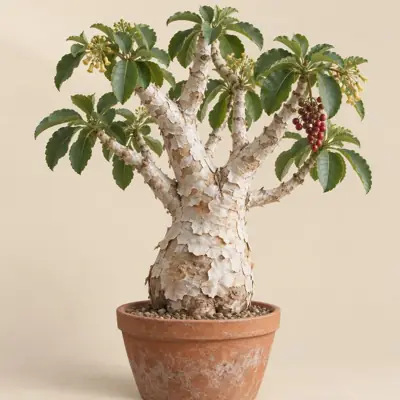
Sources differ on mature height, reporting about 100–200 cm, and the plant grows slowly. The large, thick, fleshy leaves range from blue-green to green and have serrated margins; young plants may have simple, deeply divided leaves, while mature plants may develop trifoliate leaves with winged petioles, and new leaves may initially be purple before the foliage is shed during winter or dry dormancy. The inconspicuous flowers range from near the color of the leaves to creamy yellow, with some sources describing them as yellow and tubular, and flowering is generally reported in summer, particularly early summer. The plant has a swollen stem, and its fruits occur in grape-like clusters that change from green through yellow and red to burgundy or purple-black.
Light
Sources differ in their descriptions of light requirements: ample sunlight is preferred, while afternoon shade may be provided in hot areas to avoid leaf scorch.
Watering
It is drought tolerant; during summer growth it can be watered generously to moderately while avoiding overwatering, and it should be kept dry or given very little water during winter dormancy to reduce the risk of rot. It is reported that, while in leaf, water when the mix has dried; withhold water while leafless.
Humidity and airflow
It is reported to prefer high humidity.
Temperature and dormancy
Sources differ on the reported minimum temperature, placing it at about -3 °C, while the few available sources report a maximum of about 40 °C. A cold minimum of -3 °C is given, and the plant tolerates brief light frost. It drops its leaves and goes dormant, with dormancy triggered by drought; it is also reported to have high heat tolerance. A USDA hardiness-zone classification is reported for the species.
Growing medium and mounting
Use a fertile, fast-draining cactus-type medium; for plants grown in the ground, loam or sandy soil can be used, with good drainage being the key requirement. It needs a fast-draining mix.
Feeding
It can be fertilized during summer growth, and regular watering together with fertilizing can promote growth.
Propagation
Propagation can be by seed or cuttings; seeds can be sown in moist sterile medium during winter, although germination is slow and uneven. Cuttings can be rooted in coarse river sand, and watering should remain cautious after rooting.
Common problems
It is reported that overwatering can kill the plant, with wet winter conditions posing a particular rot risk, while intense light in hot conditions can cause leaf scorch. Young plants especially should be protected from freezing; mature plants can briefly tolerate cold conditions, though frost is generally best avoided, and overly wet winter conditions are also unsuitable.
Identification
Cyphostemma juttae is distinguished by its massive, bottle-shaped swollen water-storing stem or caudex, yellow-green to pale peeling papery bark, a crown of large serrated leaves, and grape-like fruit clusters.
Photos


Sources
- Wikipedia (en): Cyphostemma juttae — CC BY-SA 4.0 · link
- Wikipedia (fr): Cyphostemma juttae — CC BY-SA 4.0 · link
- Wikipedia (es): Cyphostemma juttae — CC BY-SA 4.0 · link
- LLIFLE Encyclopedia of living forms: Cyphostemma juttae — CC BY-SA · link
- Desert-Tropicals: Cyphostemma juttae — © Philippe Faucon (desert-tropicals.com), facts only · link
- The Succulent Plant Page: Cyphostemma (genus-level) — © R.J. Hodgkiss, facts only · link
- Top Tropicals catalog: Cyphostemma juttae — © Top Tropicals LLC (facts only) · link
- PUKUBOOK: Cyphostemma juttae — CC BY-NC (facts only) · link
- Cyphostemma juttae | Giromagi cactus and succulents for sale | Buy plants online (www.giromagi.com) — facts only (§12) · link