
Flatsedge (Cyperus involucratus)
Cyperus is reported to comprise sedge-like herbs that often grow in clumps, with many species being aquatic plants. Species may be annual or perennial.
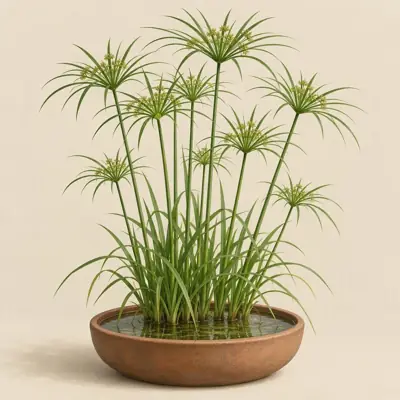
Overview
Cyperus is reported to comprise sedge-like herbs that often grow in clumps, with many species being aquatic plants. Species may be annual or perennial.
Origin and habitat
Cyperus is reported from tropical and temperate regions worldwide, while another account broadly describes its origin as involving the Southern Hemisphere and parts of the Northern Hemisphere. Many species are reported to grow in still or slow-moving water and are suited to ponds, shorelines, and riverbanks; some species can also grow submerged to varying depths. The genus is reported from both tropical and temperate regions.
Characteristics
Sources differ on mature height, giving a range of about 5–500 cm. Cyperus is reported to grow rapidly. The green leaves are reported to be narrow, linear, and grass-like, usually concentrated at the plant base; some descriptions also report whorls of leaf-like structures at the tops of flowering stems, with entire and hairless leaf margins. The small flowers are reported to be mainly green to pale brown, clustered near the stem tips, and primarily wind-pollinated; flowering is reported from summer through autumn, and the fruit is described as a small achene-like nut that may be three-angled.
Light
Cyperus is reported to grow in full sun to partial sun.
Watering
Most species are reported to prefer moist to waterlogged conditions, and many grow in still or slow-moving water, although species differ and some can also grow in well-drained soil.
Temperature and dormancy
A source reports Cyperus across a range of hardiness zones.
Growing medium and mounting
Cyperus is reported to grow in loamy or sandy soils across acidic, neutral, and alkaline conditions, with drainage requirements varying by species from well-drained ground to occasional flooding or frequent standing water.
Propagation
Cyperus is reported to be propagated by seed, while some species also spread by tubers.
Common problems
The source reports no notable insect pest problems or notable disease problems. Some species are reported to be weedy or invasive and should be assessed by species before planting; certain tuber-forming species can spread substantially.
Identification
Stems are reported to be leafless along much of their length and may be circular or triangular in cross-section depending on the species; leaves are concentrated mainly at the base, and flowering stems often bear whorls of leaf-like structures at their tips.