
lemon grass (Cymbopogon citratus)
Cymbopogon citratus is a perennial, aromatic grass that forms dense clumps with short rhizomes and may remain evergreen in suitable climates, although sources describe its evergreen habit differently.
Overview
Cymbopogon citratus is a perennial, aromatic grass that forms dense clumps with short rhizomes and may remain evergreen in suitable climates, although sources describe its evergreen habit differently.
Origin and habitat
Sources differ on the native range of Cymbopogon citratus: most point to tropical or South Asia, especially southern India and Sri Lanka, while some include Malaysia or the wider maritime Southeast Asia, and others regard its wild origin as uncertain. It occurs in tropical regions and is widely cultivated in tropical and subtropical areas; some sources describe open, relatively dry tropical soils, while its wild habitat has also been reported as unknown. It prefers a warm tropical to subtropical climate with ample sunlight and does not tolerate prolonged cold or frost.
Characteristics
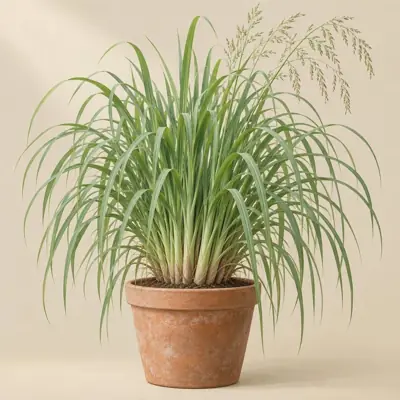
Sources differ on mature size, with height reported at about 100–200 cm and, from few sources, spread at about 50–100 cm. The aromatic leaves are narrow and linear to linear-lanceolate, often pale to blue-green, with parallel veins and margins that may be rough and sharp; sources differ in descriptions of their dimensions. The inflorescence is a large, branched, loose panicle that may have green, reddish-brown, or yellowish-brown tones, and flowering may be rare under cultivation. A single source reports flowering from late summer into autumn and says flowering is rare in greenhouse cultivation.
Light
Cymbopogon citratus prefers full sun, while indoor cultivation requires bright light.
Watering
Water regularly in soil that retains moisture while draining well; the surface soil may dry slightly before watering again, while waterlogging should be avoided because it can cause root problems.
Humidity and airflow
It is reported to prefer moderate humidity.
Temperature and dormancy
The ideal temperature is 24–30 °C. Sources differ on the lower temperature threshold, reported at about 10 °C, while few sources report an upper threshold of about 34 °C. A single source reports a USDA hardiness classification for the species. It is reported to tolerate brief light frost.
Growing medium and mounting
Cymbopogon citratus requires well-drained soil; sandy soil is suitable for commercial cultivation, and the plant can also adapt to various soils while preferring a moisture-retentive medium that does not become waterlogged. Sources differ on preferred soil reaction, with some describing a narrower preference and tolerance and another describing acidic, neutral, or alkaline conditions as suitable.
Feeding
A single source reports that a very small amount of liquid fertilizer may be used while propagation cuttings are rooting in water.
Propagation
Cymbopogon citratus can be propagated by division, suckers, or seed, and rooted divisions from mature plants can be separated from the parent and planted. Fresh young stems may also root successfully; because some sources say the species rarely flowers and fruits, division is considered more practical.
Common problems
It is generally reported to have few pest or disease problems. Poor drainage may cause root rot, while excessive drying in containers can also impair growth. It does not tolerate frost or prolonged cold; mature plants may withstand brief light freezing, but other sources report severe injury or death at relatively low temperatures.
Identification
Cymbopogon citratus forms dense grassy clumps and has a strong lemon scent throughout the plant, especially in the leaves. The leaves are long and narrow, the stem bases are swollen or bulb-like, and crushing the leaves releases a distinct citrus scent.
Photos


Sources
- GBIF Backbone: Cymbopogon citratus (DC.) Stapf — CC BY 4.0 · link
- Wikipedia (en): Cymbopogon citratus — CC BY-SA 4.0 · link
- 維基百科:柠檬草 — CC BY-SA 4.0 · link
- Wikipedia (ja): レモングラス — CC BY-SA 4.0 · link
- Wikipedia (de): Zitronengras — CC BY-SA 4.0 · link
- Wikipedia (fr): Cymbopogon citratus — CC BY-SA 4.0 · link
- Wikipedia (es): Cymbopogon citratus — CC BY-SA 4.0 · link
- GBIF descriptions: Listado de especies de plantas útiles comercializadas en los mercados del distrito de Barranquilla, — per dataset · link
- NC State Plant Toolbox: Cymbopogon citratus — copyright (facts only) · link
- Wikipedia (pt): Cymbopogon citratus — CC BY-SA 4.0 · link
- Wikipedia (ko): 레몬그래스 (종) — CC BY-SA 4.0 · link
- Useful Tropical/Temperate Plants: Cymbopogon citratus — CC BY-NC-SA 3.0 (facts only) · link
- RHS Plants: Cymbopogon citratus — © RHS, facts only · link
- USDA PLANTS Database: Cymbopogon citratus — Public domain (US Government work) · link