
Noble orchid (Cymbidium goeringii)
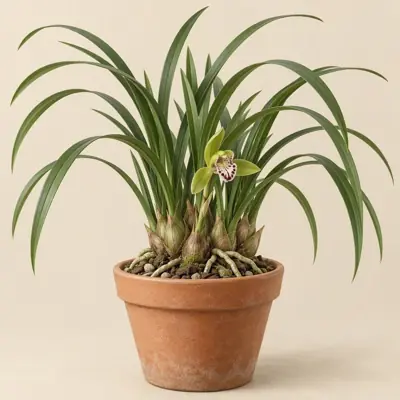
Cymbidium goeringii is a perennial evergreen terrestrial orchid that grows in clumps, with small ovoid to nearly spherical pseudobulbs and long, thick, fleshy roots; sources differ in their descriptions of its habit.
Overview
Cymbidium goeringii is a perennial evergreen terrestrial orchid that grows in clumps, with small ovoid to nearly spherical pseudobulbs and long, thick, fleshy roots; sources differ in their descriptions of its habit.
Origin and habitat
Cymbidium goeringii is native to Asia, chiefly the Himalayan region and East Asia, including Bhutan, China, northwestern or northeastern India, Taiwan, Japan, the Ryukyu Islands, and the Korean Peninsula; some records also include Myanmar and Vietnam. It occurs on rocky mountain slopes, at forest edges, and in light-filtered forest habitats; records from China describe a broad elevational range, Vietnamese records place it in primary and secondary evergreen broadleaf, mixed, and coniferous forests on limestone rock, and Taiwanese records place it in mid-elevation mountains. It is primarily adapted to temperate, relatively cool environments of the Himalayas and East Asia, while cultivation information indicates a preference for cool, shaded conditions with good ventilation.
Characteristics
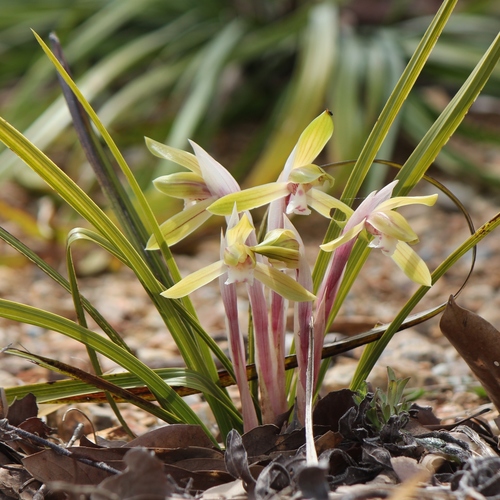
Sources are few and differ on mature size, placing height at about 50–100 cm, while a single source reports a spread of about 50–100 cm. The stiff, slender leaves grow in clusters from the pseudobulbs, are strap-shaped to linear-elliptic, arching and sharply pointed, and have finely serrated margins. Flowers generally arise from the base of the pseudobulb and are usually solitary, though some sources report multiple flowers; they range from yellow-green or green to pale brownish yellow, with a white lip marked red-purple to purple-brown, and are fragrant. Sources differ on flowering time, though flowering is mainly in spring and some sources extend the period from winter into spring; the fruit is reported to be spindle-shaped and held upright above the leaves on an elongated stalk when mature, with very fine, dust-like seeds.
Light
Cymbidium goeringii takes medium light and is grown in partial sun to partial shade with bright light while avoiding strong direct sunlight; sources differ in their specific shading guidance.
Watering
Keep the growing medium slightly dry, allowing it to become somewhat dry or dry at the surface before watering thoroughly and draining well; reduce watering in winter and avoid hot, overly wet conditions associated with root rot.
Humidity and airflow
It is generally reported to prefer high humidity and needs good airflow.
Temperature and dormancy
The ideal temperature range is 10–16 °C, and Cymbidium goeringii is cool-growing. It is reported to tolerate brief light frost.
Growing medium and mounting
As a terrestrial orchid with fleshy roots, Cymbidium goeringii favors a terrestrial mix that is loose, airy, and well drained. Suitable materials described by sources include orchid growing medium combined with granular soil, fine bark, fine stone, sphagnum moss, coconut fiber, or leaf mold; sources differ on the preferred soil reaction, while one account describes humus-rich soil.
Feeding
Orchid fertilizer may be applied during the growing period; sources give differing schedules and also describe slow-release or placed fertilizer at particular stages.
Propagation
Mature plants are mainly propagated by division, with sources recommending divisions that retain older pseudobulbs and new growth, while seed propagation requires specialized or controlled culture equipment.
Common problems
Reported pests include aphids, mites, slugs, and noctuid moth larvae, with greenhouse red spider mite also listed by RHS. Reported diseases include viral disease, gray mold, anthracnose, black spot, soft rot, and root rot. Cultivation can be difficult in hot tropical climates, especially at low elevations, and strong direct sun, extreme heat, dryness, and poor drainage should be avoided. The plant is sensitive to extreme heat, dryness, and strong direct sunlight; potted plants should avoid extreme freezing in winter, and flower buds also require protection.
Identification
Cymbidium goeringii is distinguished by small ovoid pseudobulbs, clustered slender leaves with finely serrated margins, and long, thick, fleshy roots; its fragrant flowers are generally solitary and held low among the leaves, with a white lip commonly marked in red-purple.
Photos


Sources
- GBIF Backbone: Cymbidium goeringii (Rchb.f.) Rchb.f. — CC BY 4.0 · link
- Wikipedia (en): Cymbidium goeringii — CC BY-SA 4.0 · link
- 維基百科:春蘭 — CC BY-SA 4.0 · link
- Wikipedia (ja): シュンラン — CC BY-SA 4.0 · link
- Wikipedia (es): Cymbidium goeringii — CC BY-SA 4.0 · link
- Wikipedia (ko): 보춘화 — CC BY-SA 4.0 · link
- RHS Plants: Cymbidium goeringii — © RHS, facts only · link
- AOS culture sheet: Cymbidium (genus-level) — © American Orchid Society, facts only · link
- 臺北典藏植物園 植物資料庫: Cymbidium goeringii — © 臺北典藏植物園, facts only · link
- NHK みんなの趣味の園芸 植物図鑑: Cymbidium (genus-level) — © NHK出版, facts only · link
- IOSPE PHOTOS (www.orchidspecies.com) — facts only (§12) · link