
Four-season orchid (Cymbidium ensifolium)
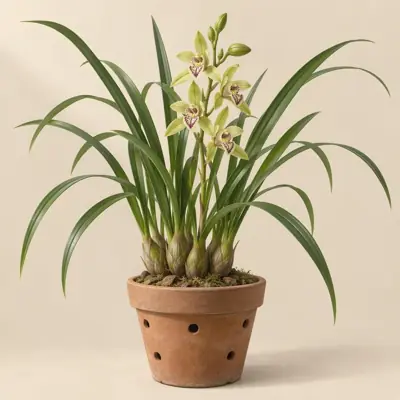
Cymbidium ensifolium is a medium-sized, clump-forming, evergreen terrestrial orchid with ovoid pseudobulbs; in some environments it can also grow lithophytically on moss-covered limestone. It is a perennial herb.
Overview
Cymbidium ensifolium is a medium-sized, clump-forming, evergreen terrestrial orchid with ovoid pseudobulbs; in some environments it can also grow lithophytically on moss-covered limestone. It is a perennial herb.
Origin and habitat
Sources differ on its native range, but accounts include Japan, China, Hong Kong, Vietnam, Cambodia, Laos, Sumatra, Java, and Taiwan, where it is listed as native. It is reported to occur in evergreen broadleaf forest as a terrestrial orchid and also on moss-covered limestone moistened by mist or splashing water near waterways, from near sea level into higher elevations. Its distribution spans temperate, subtropical, and tropical climates across East, South, and Southeast Asia, and it can grow under warm to cool conditions.
Characteristics
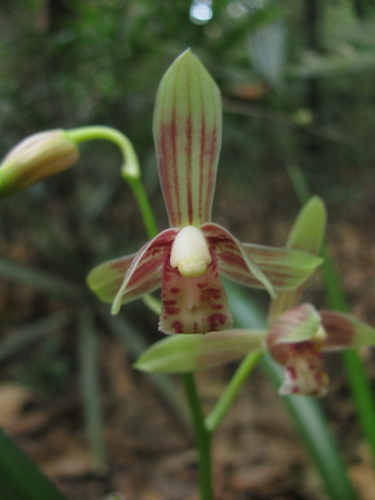
Sources differ on mature height, reported at about 50–100 cm, while the few available sources place mature spread at about 50–100 cm. The glossy leaves are strap-shaped to linear and occur in small groups on each pseudobulb. Racemes arise from the base of the pseudobulbs and are usually upright or slightly arching; the flowers are usually fragrant and commonly pale yellow-green with purple or dark red markings. Sources differ on flowering season: flowering is mainly from summer into autumn, while under some cultivated or climatic conditions plants can flower repeatedly or irregularly throughout the year; the narrowly ellipsoid fruit is a capsule.
Light
Cymbidium ensifolium is suited to medium light, including partial sun or bright diffused light, with good illumination while avoiding strong direct sunlight.
Watering
Use a well-drained, well-aerated medium and let it dry between waterings, then water thoroughly and allow excess water to drain rather than leaving it persistently waterlogged. In winter, the stated watering interval is 4–7 days.
Humidity and airflow
It is generally reported to need good airflow.
Temperature and dormancy
The few available sources report a minimum around 10 °C and a maximum around 30 °C, while sources differ on an ideal range of about 20–30 °C. It is warm-growing and is generally reported to tolerate brief light frost. A single source gives its hardiness classification as RHS H1C.
Growing medium and mounting
This terrestrial orchid has fleshy roots and favors a loose, well-drained, well-aerated orchid medium, with a bark and sphagnum mix among the recommended options. Other suggested materials include coconut fiber, horticultural grit, tree-fern fiber, leaf mold, peat, and crushed stone, and a neutral pH is also listed.
Feeding
During the growing season, orchid fertilizer can be applied regularly; another cultivation approach uses a slow-release complete fertilizer once per season.
Propagation
Cymbidium ensifolium can be propagated by division, with mature plants divided from early spring into spring; tissue culture and sterile sowing from capsules can also be used for large-scale propagation.
Common problems
It is generally reported to be susceptible to aphids, greenhouse red spider mites, scale insects, and mealybugs, while disease problems are generally uncommon. A single source reports that excessive shade can produce longer leaves with insufficient nutrient accumulation and poor flowering, and that drainage, moisture retention, and aeration in the medium need to be balanced. Cultivation is generally reported to favor a sheltered position away from strong direct sunlight.
Identification
Cymbidium ensifolium is distinguished by small ovoid pseudobulbs, slender strap-shaped leaves, and basal upright racemes; its flowers are often distinctly fragrant and it can flower repeatedly during the year, giving rise to the name meaning “four-season orchid.”
Photos


Sources
- 維基百科:建蘭 — CC BY-SA 4.0 · link
- Wikipedia (ja): スルガラン — CC BY-SA 4.0 · link
- Wikipedia (es): Cymbidium ensifolium — CC BY-SA 4.0 · link
- TaiCOL 臺灣物種名錄: Cymbidium ensifolium — CC BY 4.0 · link
- 農業知識入口網 植物圖鑑: Cymbidium ensifolium — © MOA, facts only · link
- RHS Plants: Cymbidium ensifolium — © RHS, facts only · link
- Internet Orchid Species Photo Encyclopedia: Cymbidium ensifolium — © Jay Pfahl / IOSPE contributors, facts only · link
- AOS culture sheet: Cymbidium (genus-level) — © American Orchid Society, facts only · link
- 臺北典藏植物園 植物資料庫: Cymbidium ensifolium — © 臺北典藏植物園, facts only · link
- NHK みんなの趣味の園芸 植物図鑑: Cymbidium (genus-level) — © NHK出版, facts only · link