
sago palm (Cycas revoluta)
Cycas revoluta is a perennial evergreen cycad with a palm-like woody habit, growing as a shrub or small tree with a stout stem that may branch in older plants.
Overview
Cycas revoluta is a perennial evergreen cycad with a palm-like woody habit, growing as a shrub or small tree with a stout stem that may branch in older plants.
Origin and habitat
Sources differ on its native range, describing it as native to East Asia, principally southern Japan and the Ryukyu Islands, Taiwan, and parts of southern to eastern China. Natural habitats include island hillside scrub, steep rocky ground, areas near coasts, and open woodland or hillsides in eastern China. It is suited to warm temperate, tropical, and subtropical conditions, tolerates heat and drought once established, and has limited tolerance of low temperatures and frost.
Characteristics
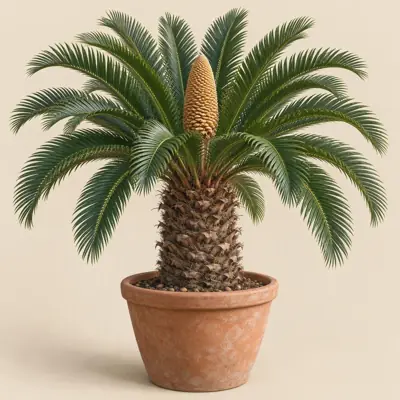
Sources differ, placing mature height at about 150–800 cm and mature spread at about 100–366 cm. Growth is very slow, and large old specimens usually take decades to develop. Large, stiff, dark green to somewhat glossy dark green pinnate leaves form a crown at the stem apex; the narrow leaflets are densely arranged with distinctly downward- or backward-rolled margins, and the petiole and base bear spines. It is a dioecious gymnosperm without true flowers or true fruit; male plants form large columnar or cone-like reproductive structures, while female plants form leaf-like, feathery, or clustered megasporophyll structures bearing exposed seeds that mature to orange-red or reddish brown and are somewhat flattened or flattened-ovoid, with reproductive structures appearing from spring into summer.
Light
Sources differ in describing light conditions: Cycas revoluta takes full sun and can grow outdoors in full sun or partial sun, while indoors it needs abundant bright light; abruptly moving a plant from indoors into intense full sun may bleach or scorch the leaves.
Watering
Cycas revoluta is drought tolerant but does poorly with waterlogging; use a well-drained medium, generally allow potting soil to dry before watering again, reduce watering in winter, and avoid persistent excess moisture that can lead to root rot.
Humidity and airflow
It is reported to prefer moderate humidity and need good airflow.
Temperature and dormancy
With only a single source available, the reported minimum is about -9.4 °C. It is reported under a USDA hardiness classification and is generally described as tolerating brief light frost.
Growing medium and mounting
A well-drained sandy or loamy medium, which may contain organic matter, is preferred; it can be acidic to neutral, and soils prone to waterlogging should be avoided. It needs a fast-draining mix.
Feeding
Its fertilizer needs are low; container plants can receive a moderate amount of balanced fertilizer in spring, with continued moderate feeding during the growing period if faster growth is desired, while plants in the ground may not require specific fertilization.
Propagation
Cycas revoluta can be propagated from seed or vegetatively by separating basal shoots, suckers, or lateral shoots.
Common problems
Recorded pests include scale insects, including cycad aulacaspis scale or Asian cycad scale, and cycad-associated butterflies whose larvae feed on young leaves. Disease problems are generally limited, but excessive moisture, overwatering, or poor drainage can cause root or plant rot. Apart from natural yellowing of older leaves, drought or deficiencies of nitrogen, manganese, or magnesium may cause leaf yellowing, while strong afternoon sun can cause leaf scorch in some growing conditions. It is drought tolerant and has some cold tolerance, but severe frost or extreme cold can damage foliage or threaten the plant; sources differ substantially on the degree of frost and snow it can withstand.
Identification
A stout stem, often covered with fibers or old leaf scars, supports an orderly crown of pinnate leaves with stiff, sharp leaflets whose margins are distinctly rolled back; although palm-like in appearance, Cycas revoluta is a cycad gymnosperm.
Photos


Sources
- GBIF Backbone: Cycas revoluta Thunb. — CC BY 4.0 · link
- Wikipedia (en): Cycas revoluta — CC BY-SA 4.0 · link
- 維基百科:苏铁 — CC BY-SA 4.0 · link
- Wikipedia (ja): ソテツ — CC BY-SA 4.0 · link
- Wikipedia (fr): Cycas du Japon — CC BY-SA 4.0 · link
- NC State Plant Toolbox: Cycas revoluta — copyright (facts only) · link
- TaiCOL 臺灣物種名錄: Cycas revoluta — CC BY 4.0 · link
- Useful Tropical/Temperate Plants: Cycas revoluta — CC BY-NC-SA 3.0 (facts only) · link
- RHS Plants: Cycas revoluta — © RHS, facts only · link
- USDA PLANTS Database: Cycas revoluta — Public domain (US Government work) · link
- PACSOA wiki: Cycas revoluta — © Palm & Cycad Societies of Australia (PACSOA) and credited contributors, facts only · link
- 臺北典藏植物園 植物資料庫: Cycas revoluta — © 臺北典藏植物園, facts only · link
- NHK みんなの趣味の園芸 植物図鑑: Cycas revoluta — © NHK出版, facts only · link
- Top Tropicals catalog: Cycas revoluta — © Top Tropicals LLC (facts only) · link