
String-Of-Beads Senecio (Curio rowleyanus)
Curio rowleyanus is a perennial evergreen succulent herb with creeping, trailing, or pendent growth; stems can root where they contact soil and form mat-like colonies, while potted plants often trail in long strands.
Overview
Curio rowleyanus is a perennial evergreen succulent herb with creeping, trailing, or pendent growth; stems can root where they contact soil and form mat-like colonies, while potted plants often trail in long strands.
Origin and habitat
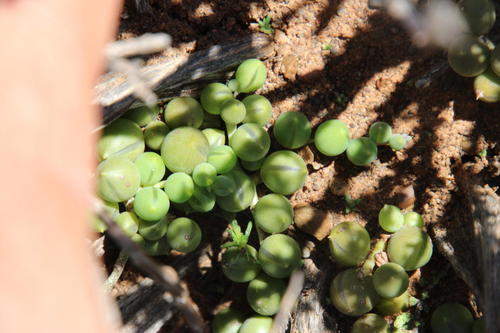
Sources differ on its native range: it is associated with southern Africa, chiefly the Cape region of South Africa, including the Eastern Cape and Western Cape, while some accounts also include Namibia or more broadly southwestern Africa. In its natural habitat it generally grows in dry areas, creeping along the ground, often in shade from shrubs, other plants, or rocks; stems root on contact with soil and form colonies. It is adapted to dry, warm environments that can experience prolonged drought.
Characteristics
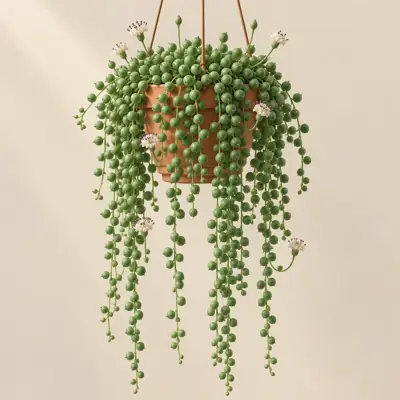
Sources differ on mature height, placing it at about 0–10 cm, while the few available sources report a mature spread of about 10–50 cm. Under favorable conditions it is reported to grow vigorously and can fill a pot. Sources differ in their descriptions of the fleshy, nearly spherical to slightly flattened, pea- or pearl-like leaves, which are green to gray-green, have a small pointed tip and a narrow translucent window-like band; it stores water in its leaves. The brush-like inflorescences consist mainly of white to cream tubular flowers without conspicuous ray florets, with anthers that may be purplish and a cinnamon-like fragrance; sources differ on flowering time, and the fruit is generally reported to be a ribbed, hairy achene with a pappus.
Light
Curio rowleyanus grows in bright light or part shade; it can accept some direct light, while multiple sources indicate that its natural habitat is often shaded and that indoor plants can receive bright indirect light with gentler direct light.
Watering
Use a well-drained medium, allow the soil to dry before watering again, avoid prolonged wetness, and reduce watering in winter.
Humidity and airflow
It prefers low humidity.
Temperature and dormancy
The ideal temperature is 21–27 °C. Sources differ on its USDA hardiness classification. It is generally reported to be frost tender and should be kept above freezing; a specialist source reports a cold minimum of about 5 °C, but sources are few. It is reported not to favor hot weather and to need cool conditions with good airflow.
Growing medium and mounting
It needs a fast-draining, well-drained medium; cactus or succulent potting mix can be used, and it can adapt to sandy, loamy, and chalky soils, with RHS listing neutral pH as suitable. It is generally reported to have low rot risk.
Feeding
A general-purpose plant fertilizer is reported to be suitable in spring and summer.
Propagation
It can be propagated by stem cuttings, softwood cuttings, internodal cuttings, and division, with RHS recommending propagation in spring and summer.
Common problems
Possible pests include aphids, mealybugs, whiteflies, and greenhouse red spider mites. Poor drainage or excessive watering can lead to rot, and the growing medium should be allowed to dry between waterings. It is sensitive to cold and should be protected from freezing when grown outdoors.
Identification
Curio rowleyanus is distinguished by nearly spherical, fleshy leaves arranged along slender trailing stems like strings of pearls, with a narrow translucent window on each spherical leaf; it can be distinguished from Curio herreanus, which has teardrop-shaped leaves, and Curio radicans, which has more elongated, pointed leaves.
Photos


Sources
- Wikipedia (en): Curio rowleyanus — CC BY-SA 4.0 · link
- Wikipedia (ja): ミドリノスズ — CC BY-SA 4.0 · link
- Wikipedia (de): Curio rowleyanus — CC BY-SA 4.0 · link
- Wikipedia (fr): Curio rowleyanus — CC BY-SA 4.0 · link
- Wikipedia (es): Curio rowleyanus — CC BY-SA 4.0 · link
- NC State Plant Toolbox: Curio rowleyanus — copyright (facts only) · link
- Wikipedia (it): Curio rowleyanus — CC BY-SA 4.0 · link
- Wikipedia (pt): Senecio rowleyanus — CC BY-SA 4.0 · link
- LLIFLE Encyclopedia of living forms: Curio rowleyanus — CC BY-SA · link
- RHS Plants: Curio rowleyanus — © RHS, facts only · link
- String of Pearls Plant:How To Grow And Care (houseplantcentral.com) — facts only (§12) · link
- How to Plant, Grow, and Care for String of Pearls (epicgardening.com) — facts only (§12) · link
- String Of Pearls Plant Care Guide - How To Grow Curio rowleyanus (getbusygardening.com) — facts only (§12) · link
- String of Pearls Plant Care Guide: How to Grow and Propagate This Stunning Succu (www.almanac.com) — facts only (§12) · link