
Gooseberry Plant (Curio herreanus)
Curio herreanus is an evergreen perennial succulent with trailing stems that can also creep along the ground. It is reported to be perennial.
Overview
Curio herreanus is an evergreen perennial succulent with trailing stems that can also creep along the ground. It is reported to be perennial.
Origin and habitat
Curio herreanus is native to Namibia.
Characteristics
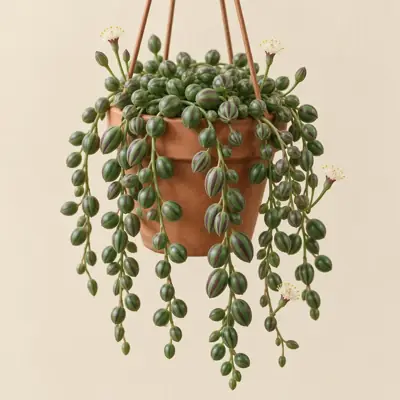
With few sources available, mature height and spread are reported at about 10–50 cm. The fleshy leaves range from roughly elliptical to nearly spherical or raindrop-shaped, with a more pointed tip; they are dark green to purplish with dark or purple longitudinal stripes, and some have translucent leaf windows, while the purple coloration deepens in bright light. The flowers are small and white, occurring in clusters or pom-pom-like forms, with conspicuously colored stamens; some sources describe a cinnamon scent, and flowering is reported to be possible in summer. It is reported to take years to reach mature size and generally stores water in its leaves.
Light
Sources describe light requirements differently: bright light is recommended, with accounts ranging from full sun to filtered or partial sun, while specific RHS cultivation guidance recommends bright conditions without direct sun. It is also reported to take full sun.
Watering
Sources describe watering differently: the growing medium should drain well without remaining waterlogged; RHS recommends more frequent watering during the growing season and avoiding excessive winter watering, while Mountain Crest Gardens recommends watering thoroughly and then waiting until the medium is completely dry before watering again.
Temperature and dormancy
With few sources available, the reported minimum temperature is about 10 °C. Sources provide USDA and RHS hardiness classifications, and Curio herreanus is frost tender; keep above freezing.
Growing medium and mounting
Use a well-drained medium, such as sandy or loamy soil, or a well-draining cactus or succulent medium amended with coarse sand, pumice, or perlite; RHS reports tolerance of acidic, neutral, or alkaline pH. It generally needs a fast-draining mix and is reported to be prone to rot.
Propagation
Curio herreanus can be propagated from stem cuttings.
Common problems
It is reported to be susceptible to mealybugs, scale insects, and greenhouse red spider mites, as well as rust and diseases associated with Armillaria. Overwatering can increase the risk of rot, so use a well-drained medium and avoid excessive watering in winter. It is reported not to tolerate severe frost and should be moved indoors when there is a risk of freezing.
Identification
Fleshy leaves are regularly spaced along trailing stems, creating a string-of-beads appearance; the leaves have purple longitudinal stripes and translucent leaf windows. It resembles plants known as string of pearls, but its leaves are larger and longer, and its purple coloration becomes more conspicuous in strong light.
Photos

