
crookneck squash (Cucurbita moschata)
Cucurbita moschata is an annual herbaceous vine whose stems trail along the ground or climb supports using tendrils.
Overview
Cucurbita moschata is an annual herbaceous vine whose stems trail along the ground or climb supports using tendrils.
Origin and habitat
Cucurbita moschata is native to tropical parts of the Americas, broadly including Central America and areas from northern South America through South America, but sources differ on its exact center of origin. It is now mainly found in agricultural, horticultural, and home-growing settings; its wild habitat is unclear, and the sources indicate that no wild form is currently known. It is a warm-season crop adapted from warm-temperate to tropical environments, particularly hot, humid tropical climates, and it is generally more tolerant of heat and humidity than some other cultivated squashes.
Characteristics
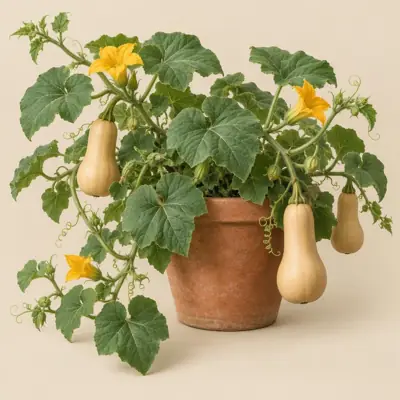
Sources differ on mature size, placing height at about 50–100 cm and spread at about 400–800 cm; the available sources for these ranges are few. It grows rapidly and has large, hairy, green leaves that range from broadly ovate-heart-shaped to nearly round, may be shallowly lobed and white-mottled, and have palmate veins and potentially toothed margins. The plant is monoecious with separate unisexual male and female flowers borne singly in the leaf axils; the flowers are yellow to orange, and flowering is reported to occur in summer. Fruit varies in shape and color; butternut types are commonly elongated cylindrical to bottle-shaped with an expanded end away from the stalk, while mature fruits have smooth, hard skin often in pale orange to cream tones, thick orange flesh with a sweet flavor, and good storage after maturity.
Light
Cucurbita moschata grows in full sun, with a warm, sunny, relatively sheltered position preferred.
Watering
The soil should remain moderately moist while draining well, retaining moisture without becoming waterlogged because excessive soil saturation is unfavorable for the roots.
Temperature and dormancy
A limited source reports an approximate temperature range of 10–40 °C; sources for these limits are few. An RHS hardiness classification is also reported by a single source.
Growing medium and mounting
Cucurbita moschata favors fertile soil that retains moisture while draining well and can grow in loamy or sandy soil; the sources also describe a preferred soil acidity range and a broader tolerated range.
Feeding
A single source reports that a high-potassium fertilizer can be applied regularly during growth.
Propagation
Cucurbita moschata is propagated by seed; it can be sown directly from seed when the soil is warm or sown indoors in spring and later transplanted.
Common problems
It may be affected by pests associated with cucurbit crops, although sources also indicate that Cucurbita moschata has greater resistance to some insects, particularly squash vine borer. Downy mildew, gummy stem blight, anthracnose, and powdery mildew may occur, while Cucurbita moschata is generally more resistant to some diseases than certain other cultivated squashes. The roots are sensitive to prolonged excessively wet soil, and white-tailed deer are also listed as a potential source of plant damage; the plant requires a warm growing season, can be killed by freezing conditions, and, despite adapting to heat and humidity, favors a warm, sunny, relatively sheltered site.
Identification
Cucurbita moschata has long vines with tendrils, and mature fruit may be bottle-shaped or club-shaped with an expanded end and orange flesh; the fruit stalk has prominent ridges and expands where it joins the fruit.
Photos


Sources
- Wikipedia (en): Cucurbita moschata — CC BY-SA 4.0 · link
- 維基百科:中国南瓜 — CC BY-SA 4.0 · link
- Wikipedia (ja): ニホンカボチャ — CC BY-SA 4.0 · link
- Wikipedia (de): Moschus-Kürbis — CC BY-SA 4.0 · link
- Wikipedia (fr): Courge musquée — CC BY-SA 4.0 · link
- Wikipedia (es): Cucurbita moschata — CC BY-SA 4.0 · link
- GBIF descriptions: Checklist of introduced taxa in Cyprus; DAISIE - Inventory of alien invasive species in Europe; Glob — per dataset · link
- NC State Plant Toolbox: Cucurbita moschata — copyright (facts only) · link
- Useful Tropical/Temperate Plants: Cucurbita moschata — CC BY-NC-SA 3.0 (facts only) · link
- RHS Plants: Cucurbita moschata — © RHS, facts only · link
- USDA PLANTS Database: Cucurbita moschata — Public domain (US Government work) · link