
garden cucumber (Cucumis sativus)
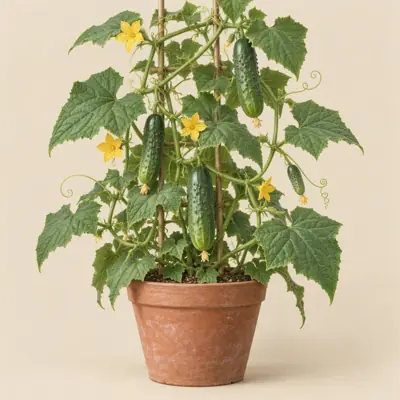
Cucumis sativus is an annual climbing or trailing herbaceous vine that uses tendrils to attach to supports and can also spread along the ground.
Overview
Cucumis sativus is an annual climbing or trailing herbaceous vine that uses tendrils to attach to supports and can also spread along the ground.
Origin and habitat
Sources differ on its native range: it is placed in Asia, more specifically often from northern India toward the Himalayan foothills, while some sources extend the range to southwestern China, the Indian subcontinent, Indochina, and northern Thailand. Its original wild habitat is unclear, and it is now widely cultivated in agricultural, horticultural, and home-growing settings from temperate to tropical regions. It prefers a warm, sunny growing season, can adapt to cooler climates than some fruiting vegetables, does not tolerate frost, and can be grown from temperate to tropical regions.
Characteristics
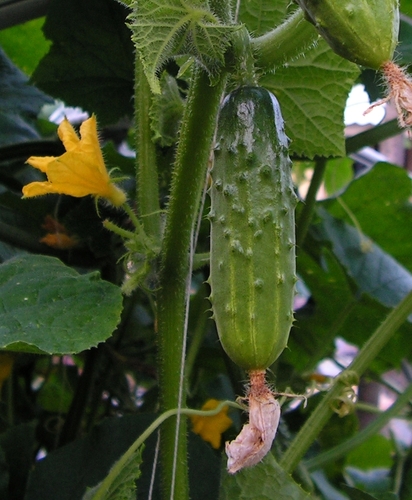
Sources are few and differ on mature height, placing it at about 10–50 cm; a limited source reports a mature spread of about 150–250 cm. It grows rapidly, with vines extending quickly under suitable conditions. The leaves are reported to be large enough to cover the fruit, alternate, commonly angular-heart-shaped to heart-shaped or ovate with palmate lobes, while the stems and leaves are hairy. The flowers are yellow, usually with separate male and female flowers on the same plant; female flowers may occur singly or in clusters, while the fruit is a pepo, usually elongated cylindrical to oblong, generally green when immature, sometimes with bumps or spines, with spineless forms also occurring, and it may become yellow-green at maturity.
Light
Cucumis sativus prefers full sun in a warm, sunny position.
Watering
It has high water needs and should receive consistent moisture during growth while maintaining good drainage; avoiding wetting the leaves when watering can reduce the risk of fungal disease.
Humidity and airflow
It needs little air movement.
Temperature and dormancy
A limited source reports an ideal temperature range of about 18–32 °C, with a lower value of about 6 °C and an upper value of about 38 °C; sources are few.
Growing medium and mounting
It prefers fertile soil that retains moisture while draining well; loam or sandy soil can be used, with slightly acidic to neutral conditions preferred.
Propagation
Propagation is by seed, which can be sown directly after the last frost or started indoors earlier and then transplanted.
Common problems
It is generally reported to be affected by insects and related pests common to cucurbit crops, and white-tailed deer may also feed on it. Downy mildew, anthracnose, powdery mildew, and gummy stem blight may occur, with high humidity particularly increasing the risk of downy mildew. Poor drainage, prolonged leaf wetness, and high humidity can increase disease risk. It is reported to be intolerant of frost and may need protection from strong winds.
Identification
Cucumis sativus can be recognized by its climbing tendrils, large leaves, separate yellow male and female flowers on the same plant, and elongated cylindrical fruit whose surface often bears bumps or spines.
Photos


Sources
- Wikipedia (en): Cucumber — CC BY-SA 4.0 · link
- 維基百科:黄瓜 — CC BY-SA 4.0 · link
- Wikipedia (ja): キュウリ — CC BY-SA 4.0 · link
- Wikipedia (fr): Concombre — CC BY-SA 4.0 · link
- Wikipedia (es): Cucumis sativus — CC BY-SA 4.0 · link
- GBIF descriptions: Manual of the Alien Plants of Belgium; The checklist of alien seed plants of D.R. Congo, based on ev — per dataset · link
- NC State Plant Toolbox: Cucumis sativus — copyright (facts only) · link
- TaiCOL 臺灣物種名錄: Cucumis sativus — CC BY 4.0 · link
- Useful Tropical/Temperate Plants: Cucumis sativus — CC BY-NC-SA 3.0 (facts only) · link
- RHS Plants: Cucumis sativus — © RHS, facts only · link
- USDA PLANTS Database: Cucumis sativus — Public domain (US Government work) · link