
melon (Cucumis melo)
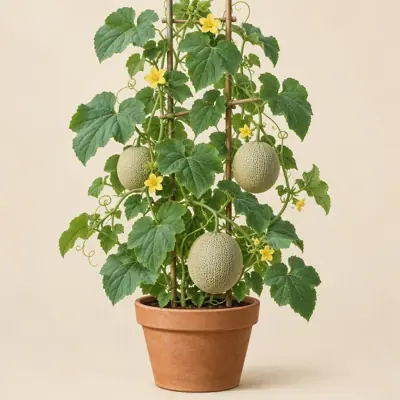
Cucumis melo is an annual trailing, creeping, or climbing herb that can spread along the ground or climb supports by tendrils.
Overview
Cucumis melo is an annual trailing, creeping, or climbing herb that can spread along the ground or climb supports by tendrils.
Origin and habitat
Sources differ on the exact native range or center of origin, variously involving Africa, the Arabian Peninsula, parts of Asia from West Asia to India, and, in some accounts, Australia and New Guinea. It is a long-cultivated plant whose truly wild habitat is unknown, and it can escape as a weed in cultivated or other disturbed sites. It is suited to warm-temperate through tropical environments, particularly subtropical or warm temperate climates; excessive rainfall or high humidity may reduce pollination and increase foliar disease.
Characteristics
Sources differ, with few sources supporting a mature height of about 183–274 cm and a mature spread of about 100–150 cm. The petioled leaves are usually nearly round to somewhat heart-shaped, may have rounded angles and finely toothed margins, and can have a softly hairy surface. The flowers range from pale yellow to yellow; sources differ in describing sexual expression, with plants potentially bearing separate male and female flowers on the same plant, while many cultivars bear male and bisexual flowers on the same plant, and in the former type male flowers can occur in small clusters while female flowers are solitary. The fruit is a pepo ranging from nearly spherical to elliptical and varies greatly among cultivars; the rind may be smooth, longitudinally ribbed or grooved, wrinkled, or netted, while the flesh can be green, yellow, orange, or white and range from sweet to relatively bland.
Light
Cucumis melo favors full sun in a warm location with abundant sunlight.
Watering
The soil should remain moist or retain moisture while draining well; excessive rainfall and high humidity are unfavorable.
Humidity and airflow
It is reported to prefer high humidity.
Temperature and dormancy
With few sources available, the reported lower temperature is about 9 °C, the reported ideal range is about 18–30 °C, and the reported upper temperature is about 35 °C.
Growing medium and mounting
Cucumis melo prefers fertile, organic-rich, well-drained soil and can grow in loam or clay; it is also reported to tolerate sandy and calcareous soils. Suitable soil should retain some moisture, with acidic to neutral conditions commonly recommended and other reported preferences and tolerances extending across a broader pH range.
Feeding
It is suited to fertile, nutrient-rich soil, and adding organic matter supports growth.
Propagation
Cucumis melo is propagated by seed, which can be sown outdoors after the last frost or started indoors before the average last frost.
Common problems
Arthropod pests can include cucumber beetles, Aphis gossypii, melonworm moth, and pickleworm. Common diseases include powdery mildew, downy mildew, anthracnose, and gummy stem blight. High humidity or excessive rainfall may reduce pollination and increase foliar disease, while rotation with non-cucurbit crops can reduce the risk of some diseases. The plant does not tolerate frost and requires warm conditions; frost can kill it, while excessive rainfall or humidity is also unfavorable to growth and health.
Identification
Cultivated forms within Cucumis melo are highly diverse, with prominent differences in smooth, netted, longitudinally grooved, or wrinkled rinds as well as flesh color, sweetness, and aroma; the tendrils are solitary and unbranched.
Photos


Sources
- Wikipedia (en): Cucumis melo — CC BY-SA 4.0 · link
- 維基百科:甜瓜 — CC BY-SA 4.0 · link
- Wikipedia (ja): メロン — CC BY-SA 4.0 · link
- Wikipedia (de): Zuckermelone — CC BY-SA 4.0 · link
- Wikipedia (fr): Melon (plante) — CC BY-SA 4.0 · link
- Wikipedia (es): Cucumis melo — CC BY-SA 4.0 · link
- GBIF descriptions: Manual of the Alien Plants of Belgium; The checklist of alien seed plants of D.R. Congo, based on ev — per dataset · link
- NC State Plant Toolbox: Cucumis melo — copyright (facts only) · link
- Useful Tropical/Temperate Plants: Cucumis melo — CC BY-NC-SA 3.0 (facts only) · link
- RHS Plants: Cucumis melo — © RHS, facts only · link
- USDA PLANTS Database: Cucumis melo — Public domain (US Government work) · link