
Fishbone Prayer Plant (Ctenanthe burle-marxii)
Ctenanthe burle-marxii is a clumping evergreen perennial herb that can be grown as a tropical groundcover or an indoor foliage plant. It is generally reported to be an evergreen perennial.
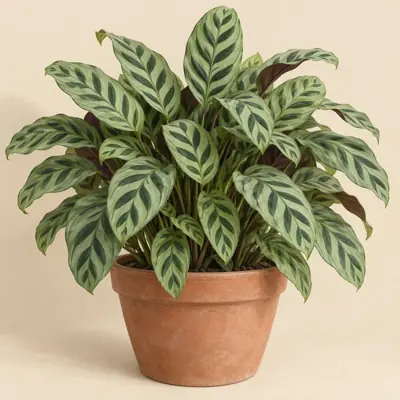
Overview
Ctenanthe burle-marxii is a clumping evergreen perennial herb that can be grown as a tropical groundcover or an indoor foliage plant. It is generally reported to be an evergreen perennial.
Origin and habitat
Ctenanthe burle-marxii is native to Brazil. It is reported to suit tropical groundcover conditions in shaded settings.
Characteristics
Sources differ on mature height, placing it at about 50–100 cm. A single source reports a mature spread of about 10–50 cm. The light green leaves range from elongated elliptical to ovate, with alternating dark green bands forming a fishbone pattern and purple undersides; the leaves fold together at night. It is reported to produce small clusters of white flowers at the ends of long flower stalks, with flowering occurring intermittently throughout the year.
Light
It grows in partial shade, while indoor cultivation calls for bright, indirect light.
Watering
It is generally reported to need thorough watering from spring through summer; in winter, the potting medium should remain moist without poor drainage, and the medium should be moist and well drained.
Growing medium and mounting
It is reported to grow in loam; indoors, a peat-free, loam-based potting medium can be used and should remain moist but well drained, with acidic, neutral, or alkaline conditions all suitable.
Feeding
It is generally reported to be fed with a general liquid fertilizer regularly from spring through summer.
Propagation
It is reported to be propagated from seed or by division in spring.
Common problems
It is reported to be susceptible to mealybugs but generally to have few diseases. It is reported to be cold-sensitive and should be grown in a sheltered setting; indoors, temperatures should remain stable and drafts should be avoided.
Identification
Ctenanthe burle-marxii can be identified by its light green leaf surfaces with alternating dark green bands forming a fishbone pattern, purple leaf undersides, and leaves that fold together at night.
Photos

