
Earth Star (Cryptanthus bivittatus)
Cryptanthus bivittatus is a terrestrial, stemless or nearly stemless herbaceous plant that forms low, spreading rosettes in clumps. It is an evergreen perennial; each rosette gradually dies after flowering, while lateral shoots continue the plant's growth.
Overview
Cryptanthus bivittatus is a terrestrial, stemless or nearly stemless herbaceous plant that forms low, spreading rosettes in clumps. It is an evergreen perennial; each rosette gradually dies after flowering, while lateral shoots continue the plant's growth.
Origin and habitat
It is native to Brazil, but sources differ on the more specific range, variously indicating eastern Brazil or an endemic range in Pernambuco in northeastern Brazil. It is terrestrial and is associated with forests of eastern Brazil. It is reported to be a tropical plant, grown mainly indoors or in greenhouses in temperate regions, and is frost-sensitive.
Characteristics
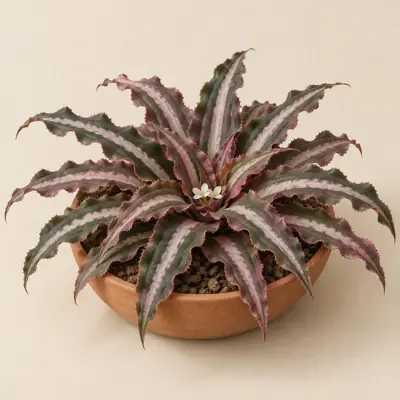
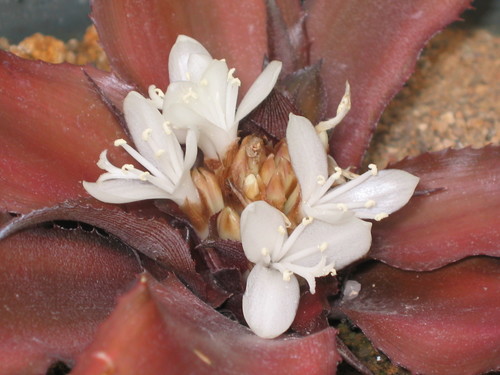
Sources differ on mature height, giving a range of about 0–10 cm, while a single source reports a mature spread of about 10–50 cm. The leaves are densely arranged in a basal rosette; they are leathery, lance-shaped to strap-shaped, with finely serrated and distinctly wavy margins, and may range from dark green to pink or purple with pale longitudinal stripes that can appear ivory-white or silver. The small, inconspicuous white to greenish-white flowers are clustered in the center of the rosette and are bisexual, radially symmetrical, and composed in threes; flowering is reported to occur in summer. The fruit is reported to be a berry.
Light
Sources differ in describing suitable light, ranging from bright filtered light to partial sun; morning or evening sun is preferable, while strong midday sun should be avoided because excessive light can bleach or shrivel the leaves, and excessive shade can fade their color. Bright indirect light is suitable.
Watering
Use a well-drained medium and water at the roots when the surface feels dry; water moderately during the growing period, reduce watering in winter, and avoid prolonged excessive wetness. Water the pot. A single source indicates that staying moist is fine.
Growing medium and mounting
Use a well-drained, humus-rich terrestrial bromeliad medium; loamy or sandy media can be used, with acidic conditions and moisture without waterlogging. It is suited to being potted.
Feeding
It is reported to benefit from diluted liquid fertilizer applied monthly during the growing period.
Propagation
It can be propagated by separating lateral shoots or by sowing seed immediately after it ripens; lateral shoots can be separated from the parent and potted once they reach a suitable proportion of the mature plant's size.
Common problems
Pests are generally uncommon, but mealybugs, scale insects, and mites commonly associated with greenhouses can cause problems. Root rot is reported to occur, and an overly wet medium may be associated with its risk. Insufficient light can cause vivid leaf color to fade, while strong sunlight can overheat, bleach, or shrivel the leaves. It is reported to be frost-sensitive, and strong midday sun and overheating can damage the leaves.
Identification
Cryptanthus bivittatus can be recognized by its low, star-shaped rosette, wavy finely serrated leaf margins, and conspicuous pale longitudinal stripes; leaf color can vary from green through pink to purple with light exposure, and the small flowers are hidden in the center of the rosette.
Photos



Sources
- Wikipedia (en): Cryptanthus bivittatus — CC BY-SA 4.0 · link
- 維基百科:绒叶小菠萝 — CC BY-SA 4.0 · link
- Wikipedia (de): Cryptanthus bivittatus — CC BY-SA 4.0 · link
- Wikipedia (fr): Cryptanthus bivittatus — CC BY-SA 4.0 · link
- NC State Plant Toolbox: Cryptanthus bivittatus — copyright (facts only) · link
- TaiCOL 臺灣物種名錄: Cryptanthus bivittatus — CC BY 4.0 · link
- RHS Plants: Cryptanthus bivittatus — © RHS, facts only · link
- 臺北典藏植物園 植物資料庫: Cryptanthus bivittatus — © 臺北典藏植物園, facts only · link
- NHK みんなの趣味の園芸 植物図鑑: Cryptanthus (genus-level) — © NHK出版, facts only · link