
Crassula perforata (Crassula perforata)
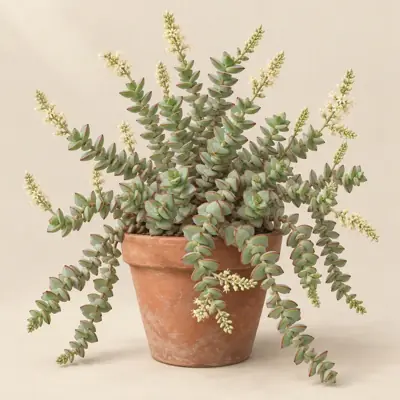
Crassula perforata is an evergreen, succulent, shrub-like perennial whose stems begin upright and may become creeping, trailing, or pendent as they lengthen, often producing a clumping appearance. It is a perennial evergreen succulent.
Overview
Crassula perforata is an evergreen, succulent, shrub-like perennial whose stems begin upright and may become creeping, trailing, or pendent as they lengthen, often producing a clumping appearance. It is a perennial evergreen succulent.
Origin and habitat
It is native to South Africa, occurring across the Cape region and extending eastward to central KwaZulu-Natal, with its western extent reaching the vicinity of Worcester. Its native habitats include scrub, rocky slopes, rock crevices, and areas around boulders, and it may grow through and over other shrubs.
Characteristics
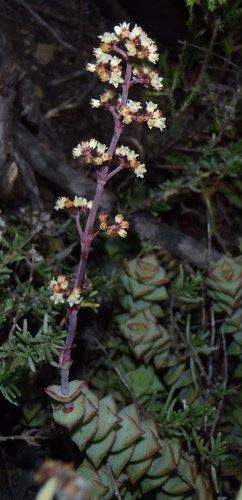
Sources differ on mature size, placing height at about 10–60 cm and spread at about 10–50 cm. It is reported to grow quickly, and its thick, fleshy gray-green to green leaves are usually triangular to broadly ovate, arranged in connected pairs that make the stem appear to pass through stacked leaves; the margins are often red, pink, or yellow, with red tones becoming more pronounced in strong light. Sources differ in their descriptions of the many small flowers and inflorescences: the flowers are generally cream-white, cream-yellow, or pale yellow with tubular corollas, while the inflorescences are typically slender and cymose-paniculate in form; flowering in the native range is mainly from Southern Hemisphere spring through summer into autumn, while cultivated plants may flower in other seasons under suitable conditions. It is reported to store water in its leaves.
Light
Crassula perforata grows in full sun to part shade and also tolerates bright light or part shade; bright light can intensify red leaf margins and help maintain compact growth and flowering, but strong midday sun should be avoided in hot regions.
Watering
Water moderately during active growth, soaking the medium and allowing it to dry before watering again; reduce watering greatly in winter or dormancy, as the plant tolerates drought and prolonged wetness should be avoided.
Humidity and airflow
It is generally reported to prefer low humidity and need good airflow.
Temperature and dormancy
Sources differ on temperature limits: one source places a minimum at about 7 °C, while a specialist source reports about -5 °C as a cold minimum. Sources differ on its hardiness classification, and it is generally reported to be frost tender and should be kept above freezing. In hot regions, protect it from strong midday sun because excessive direct sunlight can scorch the leaves.
Growing medium and mounting
Use a well-drained medium, such as loam or a sandy medium; for containers, a succulent or cactus medium can be supplemented with coarse material. It needs a fast-draining mix and is generally reported to be prone to rot.
Feeding
It is reported to accept balanced liquid fertilizer during the growing season.
Propagation
It can be propagated by stem cuttings, leaf cuttings, division, offsets, or seed, with stem cuttings described as readily successful. Propagation methods also include division, leaf cuttings, root cuttings, and stem cuttings.
Common problems
Potential pests include mealybugs, aphids, and weevils. Prolonged wetness or overwatering can cause root rot, while excessively strong direct light can scorch leaves, insufficient water can cause leaf wrinkling, and inadequate light may lead to elongated growth. It does not tolerate frost, and in hot climates it needs protection from strong midday sun; in dry medium it may briefly withstand temperatures below freezing, but this should not be treated as a normal growing temperature.
Identification
Opposite leaves are joined at the base and regularly arranged along the stem, creating an appearance resembling buttons, strings of beads, or a tiered tower; compared with Crassula rupestris, Crassula perforata has more slender inflorescences and a different flowering period.
Photos


Sources
- Wikipedia (en): Crassula perforata — CC BY-SA 4.0 · link
- Wikipedia (fr): Crassula perforata — CC BY-SA 4.0 · link
- Wikipedia (es): Crassula perforata — CC BY-SA 4.0 · link
- NC State Plant Toolbox: Crassula perforata — copyright (facts only) · link
- LLIFLE Encyclopedia of living forms: Crassula perforata — CC BY-SA · link
- RHS Plants: Crassula perforata — © RHS, facts only · link
- Desert-Tropicals: Crassula perforata — © Philippe Faucon (desert-tropicals.com), facts only · link
- The Succulent Plant Page: Crassula (genus-level) — © R.J. Hodgkiss, facts only · link
- NHK みんなの趣味の園芸 植物図鑑: Crassula (genus-level) — © NHK出版, facts only · link
- PUKUBOOK: Crassula perforata — CC BY-NC (facts only) · link
- Crassula perforata - String of Buttons | MCG™ (mountaincrestgardens.com) — facts only (§12) · link
- Crassula perforata | Giromagi cactus and succulents for sale | Buy plants online (www.giromagi.com) — facts only (§12) · link