
pig's ear (Cotyledon orbiculata)
Cotyledon orbiculata is a perennial evergreen succulent shrub or subshrub with fleshy stems and leaves, often with dense branching.
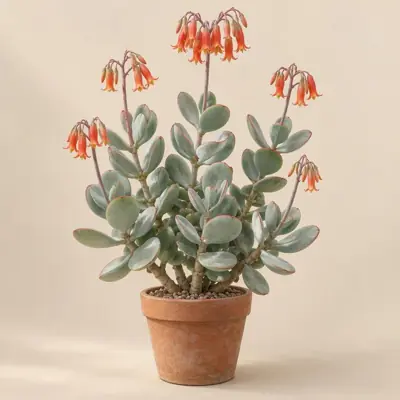
Overview
Cotyledon orbiculata is a perennial evergreen succulent shrub or subshrub with fleshy stems and leaves, often with dense branching.
Origin and habitat
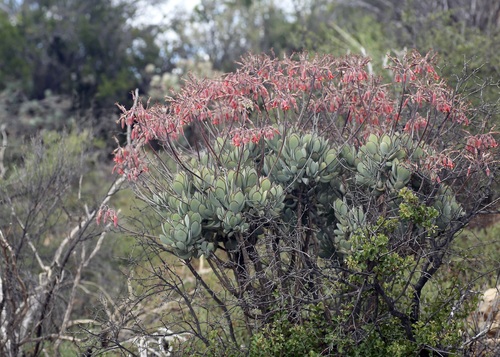
Cotyledon orbiculata is mainly native to South Africa, although sources differ on whether its native or natural distribution also extends into Namibia and southern Angola. In the wild it occurs on rocky outcrops, sandy or rocky ground, grassy slopes, grassland and scrub, including Fynbos, Karoo and Bushveld vegetation. It is adapted to dry conditions in southern Africa and, in cultivation, suits sunny, well-drained conditions with drier winters as well as Mediterranean-climate gardens.
Characteristics
Sources differ on mature size, placing height at about 50–130 cm and spread at about 10–150 cm. The opposite, succulent leaves are highly variable in shape, commonly obovate, elliptic to broadly paddle-shaped, but also nearly round, lanceolate or nearly cylindrical; they may be pale green, gray-green, gray-white or blue-gray, often with a white powdery or waxy coating and sometimes a red margin, and they store water in the leaves. The nodding, bell-shaped to tubular flowers have recurved corolla lobes and may be orange-red, red-orange, pink-orange, red or yellow; they are commonly clustered in compact inflorescences held conspicuously above the foliage. Sources differ on flowering season according to cultivation climate, while growth is reported to be moderately fast.
Light
Cotyledon orbiculata takes full sun and generally favors abundant sunlight or very bright conditions, although sources differ, with some cultivation guidance recommending light shade or partial shade during hot midsummer conditions.
Watering
In a well-drained medium, it can be watered during growth but the medium should be allowed to dry rather than remain wet for prolonged periods; watering should be greatly reduced in winter, keeping conditions nearly dry.
Humidity and airflow
It is reported to prefer low humidity.
Temperature and dormancy
Sources are few and differ on minimum temperature, with about -4 °C reported; a separate single source also reports a cold minimum of about -4 °C. Sources differ on its hardiness-zone range, and it is reported to tolerate brief light frost. It is less tolerant of intense midsummer heat and should be kept out of direct sun during the hottest part of the day and placed in partial shade.
Growing medium and mounting
It needs a fast-draining succulent or cactus mix; sandy or loamy soil can be used, and highly granular media are also suitable. It is prone to rot.
Feeding
Diluted low-nitrogen fertilizer is reported to be suitable during the warmer growing period.
Propagation
Cotyledon orbiculata can be propagated from seed or stem cuttings.
Common problems
Possible pests include mealybugs, vine weevils and aphids, while disease problems are reported to be generally uncommon. Touching or wiping the white powdery wax coating on the leaves can leave conspicuous marks, and excessive winter moisture should be avoided. It is sensitive to frost and prolonged wet conditions; drier winter conditions are preferable, and in colder areas it can be moved indoors for overwintering.
Identification
Key identifying features are thick, highly variable opposite leaves with a white powdery wax coating over gray-green to blue-gray surfaces, together with inflorescences held above the foliage bearing nodding orange-red to red bell-shaped or tubular flowers; some forms have conspicuous red leaf margins.
Photos


Sources
- Wikipedia (en): Cotyledon orbiculata — CC BY-SA 4.0 · link
- Wikipedia (de): Cotyledon orbiculata — CC BY-SA 4.0 · link
- Wikipedia (fr): Cotyledon orbiculata — CC BY-SA 4.0 · link
- Wikipedia (es): Cotyledon orbiculata — CC BY-SA 4.0 · link
- GBIF descriptions: Chapter 7: Linnaean Plant Names and their Types (part C); Species plantarum: exhibentes plantas rite — per dataset · link
- LLIFLE Encyclopedia of living forms: Cotyledon orbiculata — CC BY-SA · link
- RHS Plants: Cotyledon orbiculata — © RHS, facts only · link
- USDA PLANTS Database: Cotyledon orbiculata — Public domain (US Government work) · link
- Desert-Tropicals: Cotyledon orbiculata — © Philippe Faucon (desert-tropicals.com), facts only · link
- The Succulent Plant Page: Cotyledon (genus-level) — © R.J. Hodgkiss, facts only · link
- NHK みんなの趣味の園芸 植物図鑑: Cotyledon orbiculata — © NHK出版, facts only · link
- Top Tropicals catalog: Cotyledon orbiculata — © Top Tropicals LLC (facts only) · link
- Cotyledon orbiculata | Giromagi cactus and succulents for sale | Buy plants onli (www.giromagi.com) — facts only (§12) · link
- PUKUBOOK: Cotyledon orbiculata — CC BY-NC (facts only) · link