
rockspray cotoneaster (Cotoneaster horizontalis)
Cotoneaster horizontalis is a low, spreading to flat-branched shrub whose branches often extend horizontally and can form dense growth. It is reported to be perennial.

Overview
Cotoneaster horizontalis is a low, spreading to flat-branched shrub whose branches often extend horizontally and can form dense growth. It is reported to be perennial.
Origin and habitat
Sources differ on its native range, describing it as native to Asia, mainly from western China into other parts of China, Taiwan, and Nepal. It occurs in mountain scrub, rocky slopes, cool moist forests and forest margins, grassland, and rocky habitats. It favors cooler conditions and is often associated with temperate and mountain environments; it may perform less well where summers are hot.
Characteristics
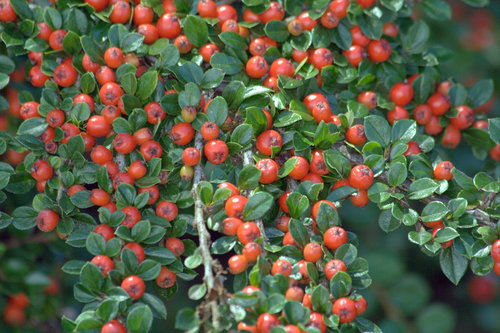
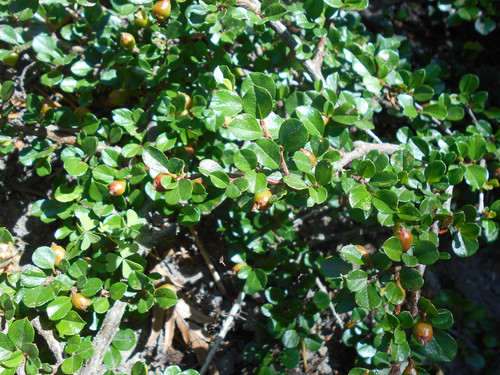
Sources differ on mature size, with height reported at about 50–100 cm and spread at about 100–150 cm. Sources differ in describing its growth as slow and its small, simple leaves as nearly round to broadly elliptic or occasionally obovate, glossy and dark green, turning orange-red to red in autumn; it is usually deciduous but can be semi-evergreen to evergreen in some more southerly environments. The small flowers have upright petals ranging from white or pinkish white to pink or red and may occur singly or in pairs; sources differ on the flowering period, placing it from late spring to early summer. The conspicuous red fruits are nearly round or elliptic pomes that ripen in autumn and are ornamental.
Light
It grows in full sun to partial shade, with RHS recommending a position in full sun.
Watering
A well-drained growing medium kept moderately moist is preferred, while established plants have some drought tolerance.
Temperature and dormancy
RHS reports a hardiness rating for Cotoneaster horizontalis.
Growing medium and mounting
Loose, well-drained loam is suitable, though it can also grow in chalk, clay, loam, and sand, tolerate poor soils, and adapt to soils ranging from acidic to alkaline.
Common problems
It is reported to be affected by lace bugs, cotoneaster webworms, and mites, with mite problems potentially more noticeable in hot, dry conditions. It is reported to be susceptible to leaf spot, canker, and fire blight. It can self-seed and produce many seedlings that may require regular removal, and it is listed in the United Kingdom as an invasive non-native plant. It generally favors a cooler climate and may perform poorly where summers are hot, while established plants have some drought tolerance.
Identification
Densely arranged side branches along horizontally spreading stems create a conspicuous fishbone or herringbone branching pattern, accompanied by small glossy green leaves, autumn color, and red fruit.
Photos


Sources
- Wikipedia (en): Cotoneaster horizontalis — CC BY-SA 4.0 · link
- 維基百科:平枝栒子 — CC BY-SA 4.0 · link
- Wikipedia (de): Fächer-Zwergmispel — CC BY-SA 4.0 · link
- Wikipedia (fr): Cotoneaster horizontalis — CC BY-SA 4.0 · link
- Wikipedia (es): Cotoneaster horizontalis — CC BY-SA 4.0 · link
- GBIF descriptions: Manual of the Alien Plants of Belgium; Database of Vascular Plants of Canada (VASCAN); DAISIE - Inve — per dataset · link
- NC State Plant Toolbox: Cotoneaster horizontalis — copyright (facts only) · link
- TaiCOL 臺灣物種名錄: Cotoneaster horizontalis — CC BY 4.0 · link
- RHS Plants: Cotoneaster horizontalis — © RHS, facts only · link
- USDA PLANTS Database: Cotoneaster horizontalis — Public domain (US Government work) · link