
garden cosmos (Cosmos bipinnatus)
Cosmos bipinnatus is an upright, branching annual herb commonly grown horticulturally for its flowers.
Overview
Cosmos bipinnatus is an upright, branching annual herb commonly grown horticulturally for its flowers.
Origin and habitat
Sources differ in their descriptions of its native range, with Mexico reported as its native range. Native-range records place it in the Mexican highlands, while in areas where it has naturalized it can also occur along roadsides, on wasteland, and in other disturbed habitats. It is suited to sunny conditions and tolerates some drought and poor soil, but is not especially tolerant of either cold or heat.
Characteristics
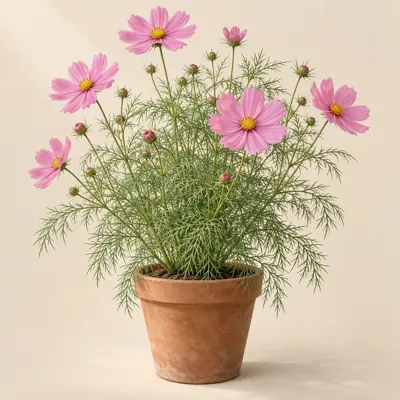
Sources differ on mature height, placing it at about 60–200 cm, while the few available sources report a mature spread of about 10–50 cm. The finely divided leaves are usually bipinnate to more deeply pinnately divided, with linear to threadlike segments that give them a delicate, feathery or lacy appearance. Sources differ in their descriptions of the flower heads, which have broad ray florets surrounding central disc florets; common colors include white, pink, red, and purple, with the central disc florets usually yellow, while the wild form is generally single-flowered and horticultural forms also include double, tubular-rayed, and multicolored types. Flowering occurs mainly from summer into autumn and can begin earlier in some early-flowering cultivars or continue longer in warm areas or under different growing conditions; the fruit is reported to be a narrow to spindle-shaped achene that becomes brown to black when mature, with a short beak and sometimes awnlike bristles at the tip.
Light
Full sun is preferred; some sources indicate that partial sun or partial shade is tolerated, but abundant sunlight is more favorable for flowering.
Watering
Sources differ in their descriptions of watering needs: soil should be kept moderately moist while seedlings establish, while established plants have some drought tolerance; good drainage is preferred and waterlogging should be avoided.
Humidity and airflow
It is reported to prefer high humidity.
Temperature and dormancy
Sources differ on the ideal temperature range, placing it at about 20–25 °C.
Growing medium and mounting
It adapts to loam, sandy loam, and various other soils, while preferring soil that is well drained, relatively light, and not excessively fertile.
Feeding
Excessive fertilization is unsuitable, especially because overly fertile soil or too much nitrogen can promote excessive leafy growth, reduce flowering, and increase the risk of lodging.
Propagation
Sources differ in their propagation information: Cosmos bipinnatus is propagated mainly by seed, while some sources also report propagation by cuttings. The reported timing and suitable temperature conditions for germination, as well as rooting time for cuttings, vary among sources.
Common problems
Potential pests include aphids, beetles, spider mites, and whiteflies, while reported diseases include leaf spot, powdery mildew, stem canker, southern blight, and gray mold. Tall plants or plants carrying flowers can become top-heavy and lodge; excessive soil fertility can encourage excessive growth and reduce flowering, while poor drainage can contribute to sowing failure. Tall cultivars may need support in strong winds or frequent storms; frost ends flowering, while high temperatures may promote leafy growth while reducing flowering and seed set.
Identification
Key identifying features are finely divided bipinnate leaves, upright highly branched stems, and large daisy-like flower heads; the epithet bipinnatus also refers to the bipinnate leaves.
Photos


Sources
- Wikipedia (en): Cosmos bipinnatus — CC BY-SA 4.0 · link
- 維基百科:大波斯菊 — CC BY-SA 4.0 · link
- Wikipedia (ja): オオハルシャギク — CC BY-SA 4.0 · link
- Wikipedia (de): Schmuckkörbchen — CC BY-SA 4.0 · link
- Wikipedia (fr): Cosmos bipinnatus — CC BY-SA 4.0 · link
- Wikipedia (es): Cosmos bipinnatus — CC BY-SA 4.0 · link
- GBIF descriptions: Manual of the Alien Plants of Belgium; The checklist of alien seed plants of D.R. Congo, based on ev — per dataset · link
- NC State Plant Toolbox: Cosmos bipinnatus — copyright (facts only) · link
- TaiCOL 臺灣物種名錄: Cosmos bipinnatus — CC BY 4.0 · link
- 農業知識入口網 植物圖鑑: Cosmos bipinnatus — © MOA, facts only · link
- Useful Tropical/Temperate Plants: Cosmos bipinnatus — CC BY-NC-SA 3.0 (facts only) · link
- RHS Plants: Cosmos bipinnatus — © RHS, facts only · link
- USDA PLANTS Database: Cosmos bipinnatus — Public domain (US Government work) · link