
sour pricklypear (Consolea rubescens)
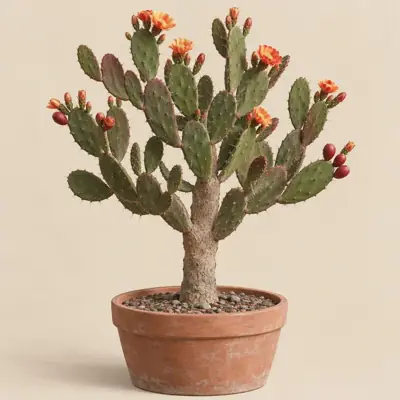
Consolea rubescens is a perennial, succulent shrub to tree-like cactus with upright growth and a branching crown. It has an opuntioid (pad-forming) growth form.
Overview
Consolea rubescens is a perennial, succulent shrub to tree-like cactus with upright growth and a branching crown. It has an opuntioid (pad-forming) growth form.
Origin and habitat
Sources differ on its native range in the Caribbean: accounts include Puerto Rico, the Virgin Islands, and the Lesser Antilles, with some describing a range from Puerto Rico to the Leeward Islands and a French source extending the distribution to Guadeloupe. It is reported from low-elevation dry environments, including coastal scrub, hillside scrub, and open woodland. It is reported to occur in a seasonally dry tropical climate and to favor dry environments that are often near the coast.
Characteristics
Sources differ on mature height, giving a range of about 0–600 cm. It is reported to grow slowly and to flower in summer. Flowers range from yellow and orange to red; some accounts describe them as changing from yellow-orange to red and opening during the day. The fruit is ovoid to nearly spherical and red or reddish brown.
Light
It generally takes full sun, with cultivation sources recommending prolonged direct sunlight; indoors, bright light or supplemental lighting is reported to be needed.
Watering
It is reported to be drought tolerant and should be watered thoroughly but at extended intervals, allowing the growing medium to become completely or noticeably dry between waterings and reducing water further in winter.
Temperature and dormancy
Sources differ on minimum temperature, with a reported value of about -4 °C. Sources also differ on the reported USDA hardiness zone. It is generally described as frost tender; keep above freezing, and it is reported to be not frost tolerant. A single source gives a cold minimum of about 0 °C.
Growing medium and mounting
It is reported to need a very fast-draining cactus or succulent mix with coarse mineral materials such as coarse sand, pumice, or perlite.
Propagation
It is reported to be propagated by cuttings or seed.
Common problems
The small glochids can be irritating, and persistently wet growing medium can lead to root rot. It tolerates high temperatures but has limited cold tolerance and is sensitive to hard frost and freezing; after freezing, continued wet conditions can increase the risk of root rot.
Identification
Consolea rubescens has an upright trunk and flattened, segmented, paddle-shaped branches; the segments are oblong to ovoid and may be dark green, reddish green, brownish green, or purple-toned. Young plants may have net-like raised patterns on the segment surfaces, while spines vary greatly in abundance, with white needle-like spines and small glochids, or the plant may be nearly spineless.
Photos


Sources
- Wikipedia (en): Consolea rubescens — CC BY-SA 4.0 · link
- Wikipedia (de): Consolea rubescens — CC BY-SA 4.0 · link
- Wikipedia (fr): Consolea rubescens — CC BY-SA 4.0 · link
- Wikipedia (es): Consolea rubescens — CC BY-SA 4.0 · link
- USDA PLANTS Database: Consolea rubescens — Public domain (US Government work) · link
- Top Tropicals catalog: Consolea rubescens — © Top Tropicals LLC (facts only) · link
- Consolea rubescens - Roadkill Cactus | MCG™ (mountaincrestgardens.com) — facts only (§12) · link
- Consolea rubescens | Giromagi cactus and succulents for sale | Buy plants online (www.giromagi.com) — facts only (§12) · link
- PUKUBOOK: Consolea rubescens — CC BY-NC (facts only) · link