
Coneplants (Conophytum calculus)
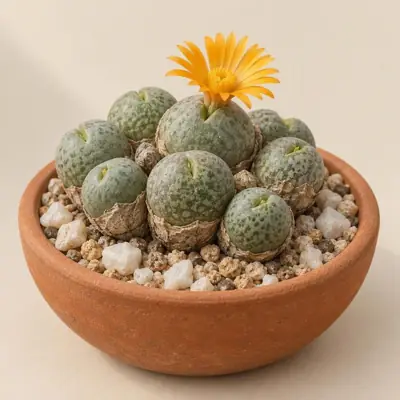
Conophytum calculus is a small, globular succulent formed by a highly fused pair of fleshy leaves, and it slowly produces offsets to form tight clumps. It is a perennial that can be very long-lived in cultivation.
Overview
Conophytum calculus is a small, globular succulent formed by a highly fused pair of fleshy leaves, and it slowly produces offsets to form tight clumps. It is a perennial that can be very long-lived in cultivation.
Origin and habitat
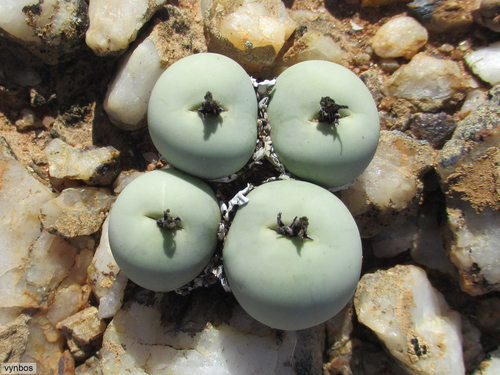
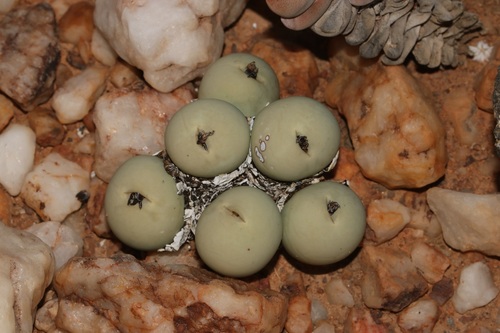
Sources differ on details of its South African range, placing it in the Cape Province and southern Namaqualand region; the typical subspecies is restricted to the far northwest of the Western Cape between Knersvlakte, Bitterfontein and Holsrivier, while subsp. vanzylii occurs farther north in western Bushmanland. It inhabits white quartz gravel in semi-arid areas, where pale quartz reflects sunlight and creates a cooler surface microenvironment than surrounding darker sandy soil and rocky ground, while the globular plants blend into the gravel. Its native climate is a semi-arid southern African winter-rainfall climate with long, dry summers, and more consistent rainfall occurs mainly in winter.
Characteristics
Few sources report a mature spread of about 0–15 cm and a mature height of about 1.6–2 cm. Each body consists of a pair of almost completely fused, fleshy, nearly spherical to slightly flattened leaves with only a small slit at the top; colors commonly range from powdery gray-green and pale blue-green to violet-blue, and new leaf pairs form inside the old leaves before emerging through the dried, shrunken sheath. It stores water in its leaves and is reported to divide slowly, gradually forming clumps with age. In autumn it produces strongly scented, mainly night-opening flowers with deep yellow to yellow-orange petals that may have brownish tips; fruit can form after flowering and yield seeds.
Light
During active growth, Conophytum calculus needs bright light or part shade and can accept direct sun, while during summer dormancy it is better kept cooler and shaded from intense exposure. Insufficient light may cause elongated growth and retention of multiple leaf pairs.
Watering
Sources differ on watering details, but describe watering during winter growth in a very well-drained medium, with pronounced wrinkling serving as a sign of water shortage. During summer dormancy it is kept dry, with only a small amount of water when severely shriveled; excessive watering can split the epidermis and increase the risk of root rot.
Humidity and airflow
It is generally reported to need good airflow.
Temperature and dormancy
Sources differ on the lower temperature threshold, with limited reports placing it at about -2 °C. A preferred temperature range and an upper temperature limit are reported, while the plant tolerates brief light frost. It rests in summer, entering dormancy during summer heat and favoring cooler, shaded conditions then.
Growing medium and mounting
A coarse, very well-drained, nutrient-poor sandy medium is suitable, and potting guidance also mentions a slightly acidic soil-and-sand mixture. It needs a very fast-draining mix, is prone to rot, and poor drainage can readily lead to root rot.
Feeding
During active growth, use fertilizer sparingly; a low-nitrogen succulent fertilizer diluted below its labeled strength is described, while genus-level guidance also supports small amounts of slow-release or liquid fertilizer during the autumn-to-spring growth period.
Propagation
Sources differ on propagation details, describing propagation by seeds, division, or cut material that includes leaf heads and part of the root system. Supported propagation methods include cuttings and division.
Common problems
Possible pests include mealybugs and scale insects, while genus-level information also records aphids, root mealybugs, slugs and noctuid larvae. Poor drainage or excessive moisture can lead to root rot, and genus-level information indicates that damp spent flowers may increase the risk of decay. Overwatering may split and scar the epidermis, insufficient water causes pronounced wrinkling, insufficient light can cause elongated growth with multiple leaf pairs retained, and poor drainage may cause root rot. It is sensitive to hot, humid summers and is best kept cool, ventilated, shaded and dry then; it tolerates brief light frost, while genus-level horticultural information recommends protection during severe cold.
Identification
Conophytum calculus has an almost spherical pair of fleshy leaves that are nearly completely fused except for a small slit at the top, giving it a pebble- or button-like appearance; the typical form is commonly uniform gray-green without conspicuous dark spots or stripes.
Photos


Sources
- Wikipedia (en): Conophytum calculus — CC BY-SA 4.0 · link
- LLIFLE Encyclopedia of living forms: Conophytum calculus — CC BY-SA · link
- The Succulent Plant Page: Conophytum (genus-level) — © R.J. Hodgkiss, facts only · link
- NHK みんなの趣味の園芸 植物図鑑: Conophytum (genus-level) — © NHK出版, facts only · link
- PUKUBOOK: Conophytum calculus — CC BY-NC (facts only) · link