
coco yam (Colocasia esculenta)
Colocasia esculenta is a large, clumping, upright herbaceous plant, with long-stalked, large leaves arising from an underground corm or thickened rhizome. It is a perennial herb and can remain evergreen in suitable tropical conditions.
Overview
Colocasia esculenta is a large, clumping, upright herbaceous plant, with long-stalked, large leaves arising from an underground corm or thickened rhizome. It is a perennial herb and can remain evergreen in suitable tropical conditions.
Origin and habitat
Sources differ on its exact native range, but generally place it from tropical Asia into East Asia, Southeast Asia, and the Indian subcontinent. It favors moist environments and can grow along lowland streams and riverbanks, in rice fields, or on land with continuous rainfall or irrigation; some varieties can grow in shallow water. It is mainly adapted to moist to highly humid tropical environments and is also widely cultivated in warm-temperate, subtropical, and other tropical and subtropical regions.
Characteristics
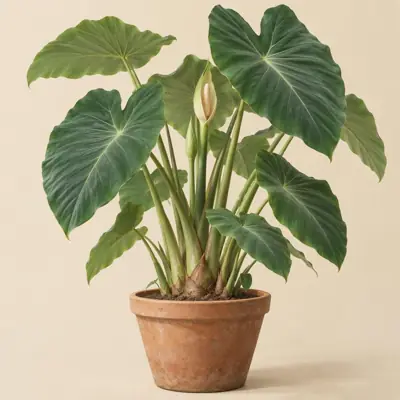
Sources differ on mature height, placing it at about 100–200 cm, while few sources report a mature spread of about 100–150 cm. Sources describe the large green, long-stalked leaves somewhat differently, ranging from heart-shaped and arrow-shaped to triangular-ovate, with some accounts describing peltate attachment; the leaf surface has fine projections that cause water droplets to roll off. Sources differ somewhat in their descriptions of the inflorescence, which consists of a spadix enclosed by a spathe, with female flowers lower and male flowers higher on the inflorescence; flowering may be less common under cultivation, and one source reports flowering in autumn. The fruit is reported to be a berry that can range from spherical to elongated-ellipsoid in shape.
Light
Sources differ on light conditions, supporting partial sun, bright indirect light, or full sun, although horticultural cultivation sources more often recommend partial shade or bright filtered light. It is reported to tolerate some direct sun.
Watering
Sources differ in detail, but during active growth the medium should remain consistently moist and moisture-retentive rather than drying out completely, and some varieties can be grown in shallow water or rice-field-like conditions. Watering is reduced in winter according to dormancy status; one account advises keeping plants only slightly moist in winter while keeping dormant corms dry and frost-free.
Humidity and airflow
Colocasia esculenta prefers high humidity.
Temperature and dormancy
Sources differ, with limited evidence placing the minimum at about 10 °C. Few sources place the ideal temperature at about 21–28 °C and the maximum at about 35 °C. One source reports a particular hardiness-zone classification and that the plant tolerates brief light frost.
Growing medium and mounting
It prefers fertile, organic-rich, moisture-retentive, relatively heavy soil; one cited account specifies loam, acidic to neutral conditions, and tolerance of relatively poor drainage. It has tuberous roots and favors a moisture-retentive mix.
Feeding
During active growth, a balanced liquid fertilizer can be applied regularly, and the plant favors fertile soil.
Propagation
It is reported to be propagated by division in winter.
Common problems
One source reports no serious pest problems and no serious disease problems. Dry conditions are reported to hinder growth, and protection from strong winds is advised. The plant is sensitive to dryness, strong winds, and frost, and dormant corms should be protected from frost.
Identification
Colocasia esculenta is distinguished by its large, long-stalked leaves and underground corm and is one of the plants commonly called elephant ears.
Photos


Sources
- Wikipedia (en): Taro — CC BY-SA 4.0 · link
- 維基百科:芋 — CC BY-SA 4.0 · link
- Wikipedia (ja): サトイモ — CC BY-SA 4.0 · link
- Wikipedia (de): Taro — CC BY-SA 4.0 · link
- Wikipedia (fr): Colocasia esculenta — CC BY-SA 4.0 · link
- Wikipedia (es): Colocasia esculenta — CC BY-SA 4.0 · link
- GBIF descriptions: The checklist of alien seed plants of D.R. Congo, based on evidence from herbarium collections; Chec — per dataset · link
- NC State Plant Toolbox: Colocasia esculenta — copyright (facts only) · link
- Wikipedia (ko): 토란 — CC BY-SA 4.0 · link
- Useful Tropical/Temperate Plants: Colocasia esculenta — CC BY-NC-SA 3.0 (facts only) · link
- RHS Plants: Colocasia esculenta — © RHS, facts only · link
- USDA PLANTS Database: Colocasia esculenta — Public domain (US Government work) · link
- Top Tropicals catalog: Colocasia esculenta — © Top Tropicals LLC (facts only) · link