
coconut palm (Cocos nucifera)
Cocos nucifera is an evergreen, single-trunked, unbranched woody palm. It is generally reported to be perennial.
Overview
Cocos nucifera is an evergreen, single-trunked, unbranched woody palm. It is generally reported to be perennial.
Origin and habitat
Sources differ on the details of its native range, describing it broadly as native to the central Indo-Pacific, particularly Southeast Asia, New Guinea, and islands of the southwestern Pacific. It commonly occurs on tropical coasts and can extend inland onto alluvial plains with a high water table; it favors well-drained conditions and is now widely cultivated throughout tropical regions worldwide. It occurs in tropical to warm, humid environments and is especially suited to the lowland tropics.
Characteristics
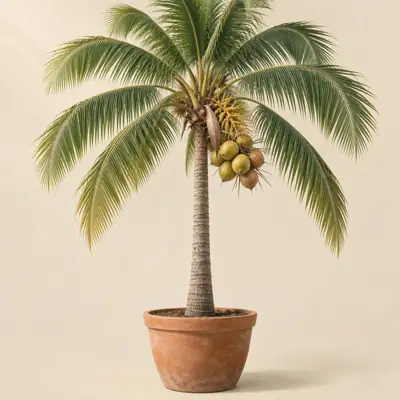
Sources differ on mature height, giving a range of about 2500–3000 cm. A limited source reports a mature spread of about 10–50 cm. Sources differ in describing its growth rate as moderate to fast; its large pinnate leaves are clustered at the top of the trunk and have narrow leaflets. Sources differ on flower color; the plant is monoecious, with large inflorescences bearing both male and female flowers, and it is reported to flower continuously without a specific season; the fruit is a drupe, usually ovoid, ellipsoid, or slightly three-angled, with a thick fibrous layer and hard endocarp, changing from commonly green or yellow when immature to brown when mature, and containing a single seed with white solid endosperm and liquid coconut water.
Light
It grows in full sun; indoors, bright light or bright filtered light can be provided.
Watering
During active growth it requires regular watering and a moist but well-drained growing medium, and it favors high-rainfall conditions; indoor plants should receive less water in winter.
Humidity and airflow
It is generally reported to prefer moderate humidity.
Temperature and dormancy
A limited source reports a minimum temperature of about 10 °C. It is generally assigned a USDA hardiness classification. It is frost tender; keep above freezing.
Growing medium and mounting
It adapts to soils ranging from coarse sand to clay but requires good drainage and aeration; loamy and sandy soils and acidic, neutral, or alkaline conditions are also described.
Feeding
During the growing season, container-grown plants are generally reported to receive a balanced liquid fertilizer.
Propagation
It is generally reported to be propagated from fresh coconuts that still retain their fibrous husk; the fruit is soaked in warm water and then partly buried in a well-drained, loam-based medium.
Common problems
Greenhouse or indoor plants may be affected by spider mites, scale insects, and mealybugs, while commercial production may also be affected by various insect pests. Sources differ in reporting infection by the plant-parasitic nematode Bursaphelenchus cocophilus and associated red ring disease, which can be fatal in severe cases. Cold, frost, and unsuitable moisture management can limit cultivation, and moisture requirements must be balanced with adequate drainage. It is sensitive to cold and frost and should be protected from freezing, while tolerating coastal salt spray and some saline or alkaline conditions.
Identification
Cocos nucifera is a tall, single-trunked palm with long pinnate leaves clustered at the top; its large fibrous drupes have a very hard endocarp, and the seed contains white endosperm and abundant liquid endosperm.
Photos

Sources
- Wikipedia (en): Coconut — CC BY-SA 4.0 · link
- 維基百科:椰 — CC BY-SA 4.0 · link
- Wikipedia (en): Coconut tree — CC BY-SA 4.0 · link
- Wikipedia (ja): ココヤシ — CC BY-SA 4.0 · link
- Wikipedia (fr): Cocotier — CC BY-SA 4.0 · link
- Wikipedia (es): Cocos nucifera — CC BY-SA 4.0 · link
- GBIF descriptions: The checklist of alien seed plants of D.R. Congo, based on evidence from herbarium collections; List — per dataset · link
- Useful Tropical/Temperate Plants: Cocos nucifera — CC BY-NC-SA 3.0 (facts only) · link
- RHS Plants: Cocos nucifera — © RHS, facts only · link
- USDA PLANTS Database: Cocos nucifera — Public domain (US Government work) · link
- Top Tropicals catalog: Cocos nucifera — © Top Tropicals LLC (facts only) · link