
Scotch attorney (Clusia rosea)
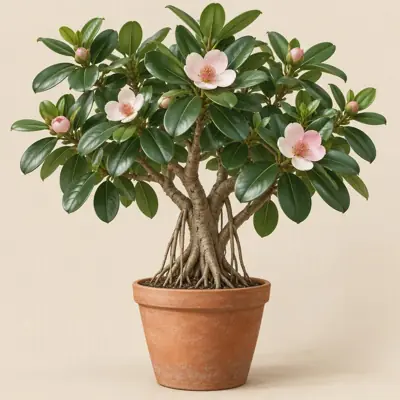
Clusia rosea is a perennial evergreen tropical shrub to tree with a semi-epiphytic habit. Young plants can grow on other trees or rocks, later developing aerial roots and a growth form resembling that of strangler figs.
Overview
Clusia rosea is a perennial evergreen tropical shrub to tree with a semi-epiphytic habit. Young plants can grow on other trees or rocks, later developing aerial roots and a growth form resembling that of strangler figs.
Origin and habitat
Sources differ on its native range, describing it as occurring in tropical and subtropical parts of the Americas, including Florida, Mexico through Central America, the Caribbean and the Bahamas, and northern South America in Colombia, Ecuador, Venezuela, and the Guyana region. It occurs along forest riverbanks and slopes and in epiphytic settings on trees or rocks, and can adapt to environments ranging from dry, exposed sites to moist, steep slopes. It occurs in tropical to subtropical climates, can tolerate a dry season, and has good tolerance of sea winds and salt spray.
Characteristics
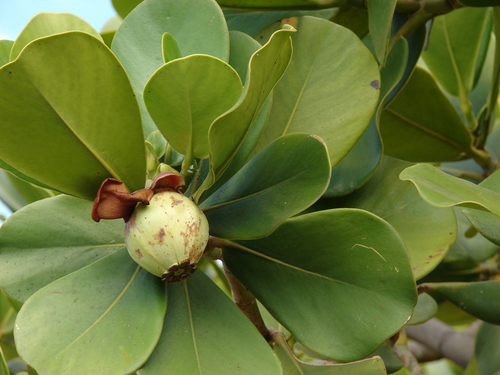
Sources differ on mature height, placing it at about 500–1800 cm, while a single source reports a mature spread of about 50–100 cm. It is reported to grow rapidly, with especially rapid growth of its aerial roots. The leaves are thick, leathery, and glossy, usually dark green with a darker upper surface and paler underside; they are mostly obovate to broadly ovate, with entire margins and rounded tips. Sources differ in their descriptions of the large, conspicuous, funnel-shaped flowers, whose petals range from white to pink; flowering occurs in summer, and the fleshy fruit can be pale green when unripe and exposes seeds with orange arils when mature or split open, with seeds eaten and dispersed by birds and other wildlife.
Light
Sources differ on light conditions, describing Clusia rosea as suitable for full sun to partial shade, while indoor or greenhouse cultivation favors bright, indirect light and avoidance of excessively intense, hot direct sunlight.
Watering
Water can be supplied freely during active growth provided the growing medium drains well, while in winter it should be kept only slightly moist. Mature plants tolerate drought as well as short periods of waterlogged soil.
Temperature and dormancy
Clusia rosea is reported to have an RHS H1A hardiness rating.
Growing medium and mounting
Use a well-drained growing medium; Clusia rosea adapts to sandy and loamy soils, and clay soil is also reported as suitable. It tolerates a broad range of soil acidity and alkalinity. For indoor cultivation, a peat-free loam-based potting medium with leaf mould and grit can be used to improve its structure.
Feeding
A single source reports that a balanced liquid fertilizer can be applied regularly during the growing period until flower buds form.
Propagation
A single source reports propagation in summer from softwood cuttings with bottom heat, or by air layering in spring or summer.
Common problems
In suitable tropical areas, Clusia rosea may spread on its own and form invasive populations, with birds helping disperse seeds after eating the fruit. Its aerial roots and rapid growth can also entangle and suppress host trees. It tolerates drought, sea winds, and salt spray but is sensitive to frost and cold winter winds.
Identification
Its thick, leathery leaves retain long-lasting marks when scratched with a sharp object, giving rise to the name "autograph tree." It also has conspicuous aerial roots and can develop from an epiphytic state into a large tree that entwines its host.
Photos


Sources
- Wikipedia (en): Clusia rosea — CC BY-SA 4.0 · link
- 維基百科:書帶木 — CC BY-SA 4.0 · link
- Wikipedia (de): Balsamapfel — CC BY-SA 4.0 · link
- Wikipedia (fr): Clusia rosea — CC BY-SA 4.0 · link
- Wikipedia (es): Clusia rosea — CC BY-SA 4.0 · link
- GBIF descriptions: Lista anotada de las especies forestales sembradas en el programa de restauración ecológica particip — per dataset · link
- Useful Tropical/Temperate Plants: Clusia rosea — CC BY-NC-SA 3.0 (facts only) · link
- RHS Plants: Clusia rosea — © RHS, facts only · link
- USDA PLANTS Database: Clusia rosea — Public domain (US Government work) · link