
Himalayan Clematis (Clematis montana)
Clematis montana is a vigorous woody climbing vine that uses twining leaf stalks to climb supports. It is a deciduous perennial.
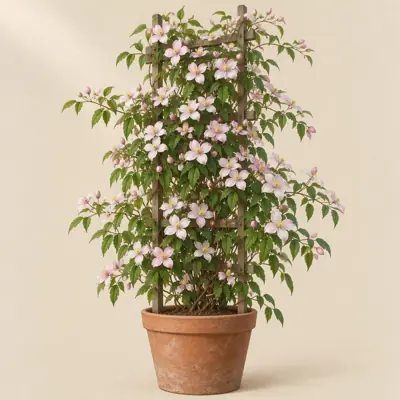
Overview
Clematis montana is a vigorous woody climbing vine that uses twining leaf stalks to climb supports. It is a deciduous perennial.
Origin and habitat
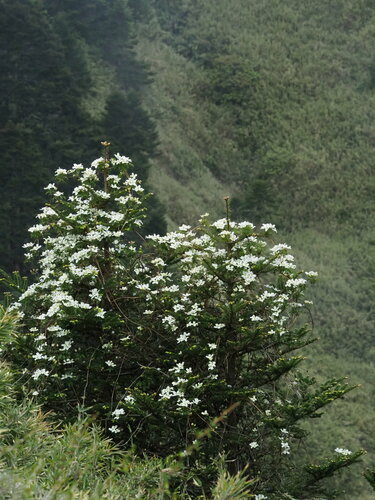
Sources differ on its native range, describing mountainous parts of Asia extending mainly from Afghanistan and the Himalayan region eastward to China and Taiwan, while Taiwan's species list treats it as native to Taiwan but not endemic. It occurs in forests, forest margins, hillsides, scrub, and along streams. It is native to mountainous Asian and warm-temperate environments, is also widely cultivated in temperate regions, and is quite cold-hardy while dormant.
Characteristics
Mature plants reach 700–1200 cm in height and 250–460 cm in spread, with fast, vigorous growth. The deciduous leaves are alternate and may be ovate, rhombic-ovate, or elliptic, either unlobed or lobed; new leaves may have bronze or purple coloration before turning green. Sources differ in their descriptions of the flowers; they are small and single in form, with petal-like sepals and conspicuous yellow anthers, while species-level information describes colors mainly from white to pink and notes fragrance in some forms. Flowering occurs mainly from spring to late spring, and the fruit is reported to consist of ovate to rhombic-ovate achenes.
Light
Clematis montana grows in full sun to partial sun; the roots and base are best kept cooler and shaded while the upper growth can grow toward the sun.
Watering
Keep the soil moist but well drained; covering the root zone can help keep the roots cool and retain moisture.
Temperature and dormancy
With few sources available, the reported minimum temperature is about -20 °C.
Growing medium and mounting
Moist, well-drained, humus-rich soil is preferred; Clematis montana can adapt to loam, clay, sand, and chalky soils, with neutral to alkaline conditions preferred.
Propagation
It can be propagated by layering, stem cuttings, semi-hardwood cuttings, or seed.
Common problems
It is reported to be affected by aphids, snails, and caterpillars, while earwigs may feed on the petals. Its vigorous growth can become extensive if uncontrolled, so it needs sufficient support space and pruning as needed to control growth. It is strongly cold-hardy when fully dormant, but its cultivated environment still requires cooler roots and well-drained soil.
Identification
Clematis montana is a large deciduous climbing vine that can produce masses of small flowers in dense cascades in late spring and climbs by means of twining leaf stalks.
Photos


Sources
- Wikipedia (en): Clematis montana — CC BY-SA 4.0 · link
- 維基百科:绣球藤 — CC BY-SA 4.0 · link
- Wikipedia (fr): Clématite des montagnes — CC BY-SA 4.0 · link
- Wikipedia (es): Clematis montana — CC BY-SA 4.0 · link
- GBIF descriptions: Manual of the Alien Plants of Belgium; DAISIE - Inventory of alien invasive species in Europe; Globa — per dataset · link
- NC State Plant Toolbox: Clematis montana — copyright (facts only) · link
- TaiCOL 臺灣物種名錄: Clematis montana — CC BY 4.0 · link
- Useful Tropical/Temperate Plants: Clematis montana — CC BY-NC-SA 3.0 (facts only) · link
- RHS Plants: Clematis montana — © RHS, facts only · link