
tangerine (Citrus reticulata)
Citrus reticulata is a perennial evergreen plant, growing as a shrub to tree whose branches may bear thorns; sources differ in descriptions of its habit.
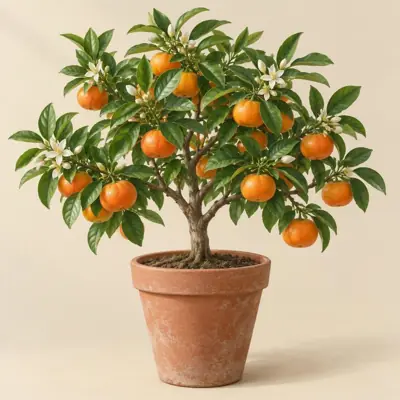
Overview
Citrus reticulata is a perennial evergreen plant, growing as a shrub to tree whose branches may bear thorns; sources differ in descriptions of its habit.
Origin and habitat
Citrus reticulata is native to Asia, but sources differ on a more precise origin, variously encompassing southern or southwestern China, Indochina, Myanmar, northeastern India, Southeast Asia, and the Philippines. Its original natural habitat is reported to be unclear, and it is now widely cultivated as a fruit tree. It is suited to tropical, subtropical, and warm-temperate conditions, with sources particularly indicating suitability to subtropical environments; it is sensitive to severe cold and frost.
Characteristics
Sources differ on mature height, placing it at about 250–800 cm, while the few available sources report a mature spread of about 100–150 cm. The evergreen leaves are glossy and aromatic, ranging from ovate and oblong to elliptic-lanceolate, with serrated margins. The small, fragrant white flowers occur singly or in small clusters, including in the leaf axils, and flowering occurs in spring. The relatively small citrus fruits are nearly spherical and slightly flattened, becoming yellow, orange, or orange-red when mature; the peel is thin, relatively loose, and readily removed by hand, while the flesh separates easily into segments and is described as sweet and aromatic.
Light
It favors full sun and bright conditions; container plants can be kept in ample light, with some shade under hot, intense light.
Watering
Keep it moderately moist with good drainage; water thoroughly during active growth without leaving the potting medium waterlogged for prolonged periods or completely dry for long periods, and container plants can be watered when the medium is nearly dry.
Humidity and airflow
It is generally reported to prefer high humidity.
Temperature and dormancy
The few available sources report an ideal temperature of about 25–30 °C, with a minimum of about -1 °C and a maximum of about 38 °C. Sources differ on its USDA hardiness-zone classification. It is generally reported to tolerate brief light frost.
Growing medium and mounting
It prefers organic-rich, well-drained loam, and sandy material can be added to improve drainage; sources recommend acidic to neutral conditions and explicitly indicate that it does not tolerate waterlogging.
Feeding
Citrus fertilizer can be applied year-round according to product directions, while another source recommends avoiding manure in container-growing media.
Common problems
Citrus plants are reported to be affected by citrus mealybugs, citrus leafminers, citrus red mites, whiteflies, and related sap-sucking pests. Citrus plants are reported to develop citrus black spot, citrus canker, and sweet orange scab. Container media that are either too wet or too dry may reportedly cause yellowing and weakening, and the plant does not tolerate waterlogging. It is sensitive to cold and can be damaged by low temperatures; mature plants withstand only brief light frost, while young plants require greater protection from cold.
Identification
Citrus reticulata is distinguished by often flattened-round fruits with thin peel that is readily removed by hand, together with evergreen glossy leaves, fragrant white flowers, and branches or stems that may bear thorns.
Photos


Sources
- Wikipedia (en): Mandarin orange — CC BY-SA 4.0 · link
- 維基百科:橘 — CC BY-SA 4.0 · link
- Wikipedia (ja): マンダリンオレンジ — CC BY-SA 4.0 · link
- Wikipedia (de): Mandarine — CC BY-SA 4.0 · link
- Wikipedia (es): Citrus reticulata — CC BY-SA 4.0 · link
- GBIF descriptions: Checklist of introduced taxa in Cyprus; Captura y almacenamiento de carbono en el arbolado del Jardí — per dataset · link
- Wikipedia (it): Citrus reticulata — CC BY-SA 4.0 · link
- Wikipedia (nl): Mandarijn (vrucht) — CC BY-SA 4.0 · link
- Useful Tropical/Temperate Plants: Citrus reticulata — CC BY-NC-SA 3.0 (facts only) · link
- RHS Plants: Citrus reticulata — © RHS, facts only · link
- USDA PLANTS Database: Citrus reticulata — Public domain (US Government work) · link
- NC State Plant Toolbox: Citrus (genus-level) — copyright (facts only) · link
- Top Tropicals catalog: Citrus reticulata — © Top Tropicals LLC (facts only) · link