
Calamondin Orange (Citrus japonica)
Citrus japonica is an evergreen, perennial woody plant, growing as a much-branched, thorny shrub to small tree and suited to container and garden cultivation.
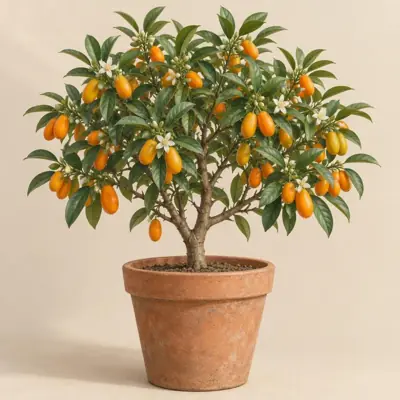
Overview
Citrus japonica is an evergreen, perennial woody plant, growing as a much-branched, thorny shrub to small tree and suited to container and garden cultivation.
Origin and habitat
Sources differ on the native range, which is described as southern to southeastern China, including the Hainan area. It is reported from evergreen broadleaf forest. Its native area has a subtropical climate; it is suited to warm to hot summers and has better cold tolerance than many cultivated citrus plants.
Characteristics
Sources differ on mature height, placing it at about 250–500 cm, while the few sources for mature spread report about 150–250 cm. The evergreen leaves are thick, glossy, and dark green, ranging from ovate-lanceolate to oblong, with very narrow wings on the petiole. The fragrant white flowers may occur singly, in small clusters, or in axillary flower clusters. Sources differ on flowering timing, describing flowering mainly from spring to early summer, with container plants potentially flowering repeatedly and producing another flush later; Nagami has oval to ovate-oval fruit that matures from orange-yellow to orange-red, with sweet peel and acidic flesh, though sources differ in their fruit descriptions.
Light
Full sun is suitable, preferably in a sheltered position protected from strong winds.
Watering
Keep the growing medium moist but well drained, avoid waterlogging, and reduce watering in winter.
Temperature and dormancy
Sources differ on the reported minimum temperature, which is about -5 °C. The few available sources report an ideal temperature of about 4–10 °C and a maximum of about 38 °C. Citrus japonica is frost hardy.
Growing medium and mounting
Good drainage is required; sources differ on suitable soils, describing a loam-based medium amended with compost and sand as well as clay, loam, sandy, and calcareous soils.
Feeding
Organic matter can be used, and container surface feeding can be applied in spring.
Propagation
It is reported to be propagated by seed or semi-ripe cuttings.
Common problems
Citrus is reported to be susceptible to citrus mealybug, leaf miner, citrus red mite, whitefly, and flatid planthoppers. Citrus is reported to be susceptible to citrus black spot, citrus canker, and sweet orange scab. Citrus japonica does not tolerate waterlogging; container or greenhouse plants may also be affected by spider mites, scale insects, aphids, and mealybugs. New spring shoots are vulnerable to frost and can be severely damaged around freezing conditions; mature dormant plants are more cold tolerant, but sheltered sites with no frost or lighter frost are preferable.
Identification
Nagami is distinguished by oval to ovate-oval fruit ranging from golden yellow to orange-red, with sweet peel and acidic flesh; the plant is evergreen and usually thorny.
Photos


Sources
- Wikipedia (en): Citrus japonica — CC BY-SA 4.0 · link
- 維基百科:金柑 — CC BY-SA 4.0 · link
- Wikipedia (fr): Citrus japonica — CC BY-SA 4.0 · link
- Wikipedia (es): Citrus japonica — CC BY-SA 4.0 · link
- Wikipedia (it): Citrus japonica — CC BY-SA 4.0 · link
- Wikipedia (pt): Citrus japonica — CC BY-SA 4.0 · link
- Useful Tropical/Temperate Plants: Citrus japonica — CC BY-NC-SA 3.0 (facts only) · link
- RHS Plants: Citrus japonica — © RHS, facts only · link