
spider plant (Chlorophytum comosum)
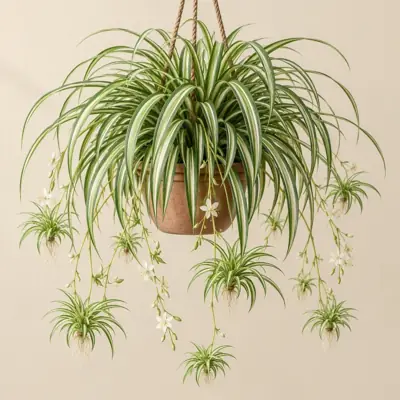
Chlorophytum comosum is a perennial evergreen herb that grows in clumps or basal rosettes and can be grown as a hanging plant, with long flower stalks and plantlets hanging downward.
Overview
Chlorophytum comosum is a perennial evergreen herb that grows in clumps or basal rosettes and can be grown as a hanging plant, with long flower stalks and plantlets hanging downward.
Origin and habitat
Chlorophytum comosum is native to Africa, with a distribution encompassing tropical and southern Africa, including areas from West Africa to Cameroon and from Ethiopia southward to South Africa; sources describe the native range differently. It is reported from rainforest and riverine forest understories, rock crevices beside streams, and more open, dry places. It is native to tropical through southern Africa and is suited in cultivation to frost-free subtropical to tropical environments; it is also widely grown indoors.
Characteristics
Sources differ on mature height, placing it at about 30–60 cm, while the few sources for mature spread report about 10–50 cm; it is reported to grow quickly. The leaves arise from the base in rosettes or clumps and are narrow, linear to linear-lanceolate, and slightly arching; wild plants have green leaves, while cultivated forms commonly have green-and-white or green-and-yellow variegation. The small white to greenish-white flowers are usually borne in loose inflorescences, whose branches can also form vegetative plantlets; flowering is reported mainly from spring through autumn, though suitable temperature and light conditions can allow flowering at other times, including winter indoors. The fruit is a capsule that can split open when mature, revealing black seeds.
Light
Bright, indirect light to partial shade is suitable; Chlorophytum comosum tolerates deeper shade, but prolonged strong direct sunlight should be avoided because it can scorch the leaves.
Watering
During active growth, keep the soil moderately moist but well drained; the fleshy roots store water and provide some drought tolerance, and watering should be reduced in winter.
Humidity and airflow
Chlorophytum comosum prefers moderate humidity.
Temperature and dormancy
Sources differ on the lower temperature figure, placing it at about 5 °C, while the few sources for the ideal temperature report about 15–25 °C. It is reported as RHS H2.
Growing medium and mounting
A well-drained, fertile or organic-rich soil is suitable; loam or sandy soil can be used, and adaptation to acidic, neutral, and alkaline soils has been recorded.
Feeding
Fertilizer can be applied in spring and summer, but excessive feeding should be avoided because it may reduce plantlet formation.
Propagation
Chlorophytum comosum can be propagated from plantlets on the flower stalks, by division, or from seed; cultivation mainly uses plantlets and division, and seed-grown offspring of variegated plants do not necessarily retain variegation.
Common problems
Scale insects and aphids may occur, and small flying insects such as fungus gnats may occur in indoor growing media. Sources differ on disease problems: one reports brown spot, while the RHS regards the plant as generally free of major disease. Brown leaf tips are common and may be associated with fluoride or chloride in tap water, insufficient water, leaf rubbing, low temperatures, or crowded roots; excessively strong direct sunlight may cause leaf scorch. Cold tolerance is limited and the plant is frost-sensitive; low temperatures or frost can damage foliage, and severe exposure may kill the above-ground growth, although regrowth may occur after temperatures rise if the thick roots survive.
Identification
Distinctive features include thick, fleshy roots that store water, narrow leaves arising from the base, and slender, branching flower stalks that later droop and bear plantlets capable of rooting.
Photos


Sources
- Wikipedia (en): Chlorophytum comosum — CC BY-SA 4.0 · link
- 維基百科:吊兰 — CC BY-SA 4.0 · link
- Wikipedia (ja): オリヅルラン — CC BY-SA 4.0 · link
- Wikipedia (de): Grünlilie — CC BY-SA 4.0 · link
- Wikipedia (fr): Chlorophytum comosum — CC BY-SA 4.0 · link
- Wikipedia (es): Chlorophytum comosum — CC BY-SA 4.0 · link
- NC State Plant Toolbox: Chlorophytum comosum — copyright (facts only) · link
- Useful Tropical/Temperate Plants: Chlorophytum comosum — CC BY-NC-SA 3.0 (facts only) · link
- RHS Plants: Chlorophytum comosum — © RHS, facts only · link
- USDA PLANTS Database: Chlorophytum comosum — Public domain (US Government work) · link