
Seifriz's chamaedorea (Chamaedorea seifrizii)
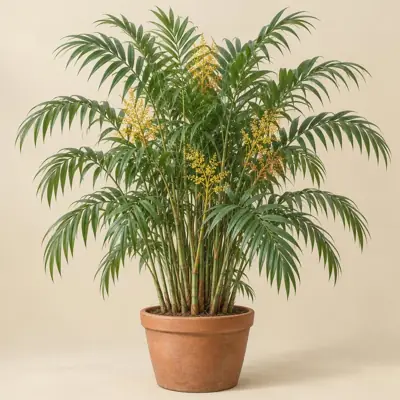
Chamaedorea seifrizii is an evergreen, clumping palm with slender, upright, bamboo-like stems; sources variously describe its habit as shrubby or tree-like. It is an evergreen perennial.
Overview
Chamaedorea seifrizii is an evergreen, clumping palm with slender, upright, bamboo-like stems; sources variously describe its habit as shrubby or tree-like. It is an evergreen perennial.
Origin and habitat
Chamaedorea seifrizii is native from southeastern Mexico to Honduras, including Mexico, Belize, Guatemala, and Honduras. It occurs in forest habitats, including disturbed forest and limestone-associated environments; sources differ in describing these habitats as moist woodland, forest, or seasonally dry forest. It occurs in subtropical to tropical environments and is suited to warm conditions.
Characteristics
Sources differ on mature height, placing it at about 200–300 cm, while a single source reports a mature spread of about 100–150 cm. It is reported to spread slowly as a clump, producing new stems from the base. The evergreen leaves are pinnate, with lance-shaped to narrowly elliptic leaflets; the terminal leaflets may be fused and can be larger. Mature plants produce small yellow flowers, and the inflorescence axis may change from green to orange or orange-red as it matures; flowering and fruiting are reported from summer to autumn, and the small, nearly round fruits become black when mature.
Light
It tolerates low light, while sources differ in supporting conditions ranging from bright light to partial sun and shade; protection may be needed under strong direct sunlight.
Watering
Keep the growing medium slightly moist but well drained; water after the surface has dried somewhat, reduce watering in winter, and avoid overwatering.
Humidity and airflow
It is generally reported to prefer moderate humidity.
Temperature and dormancy
A single source reports a USDA hardiness-zone rating for this species. It is generally reported to be frost tender and should be kept above freezing.
Growing medium and mounting
Use a well-drained growing medium; sandy loam or loam can be used outdoors and potting medium indoors, while other supported soils include chalk, clay, loam, and sand with acidic to neutral conditions.
Feeding
Fertilizer can be applied regularly during the growing season; sources support either balanced liquid fertilizer or a slow-release general fertilizer.
Propagation
Propagation is mainly by seed, and some sources also report division.
Common problems
Potential pests include mealybugs, scale insects, spider mites or glasshouse red spider mites, and thrips. Disease is generally uncommon, but overwatering can lead to root and stem rot. Indoors, watch for mealybugs, scale insects, spider mites, and thrips, while overwatering may cause root and stem rot. It is generally reported to be sensitive to frost and should be kept away from freezing conditions.
Identification
Chamaedorea seifrizii forms clumps of slender stems from the base, with conspicuous nodes that give the stems a bamboo-like appearance, together with pinnate leaves; mature inflorescence axes may turn orange to orange-red.
Photos


Sources
- GBIF Backbone: Chamaedorea seifrizii Burret — CC BY 4.0 · link
- Wikipedia (en): Chamaedorea seifrizii — CC BY-SA 4.0 · link
- Wikipedia (fr): Chamaedorea seifrizii — CC BY-SA 4.0 · link
- NC State Plant Toolbox: Chamaedorea seifrizii — copyright (facts only) · link
- RHS Plants: Chamaedorea seifrizii — © RHS, facts only · link
- USDA PLANTS Database: Chamaedorea seifrizii — Public domain (US Government work) · link
- 臺北典藏植物園 植物資料庫: Chamaedorea seifrizii — © 臺北典藏植物園, facts only · link
- Top Tropicals catalog: Chamaedorea seifrizii — © Top Tropicals LLC (facts only) · link