
hearts entangled (Ceropegia woodii)
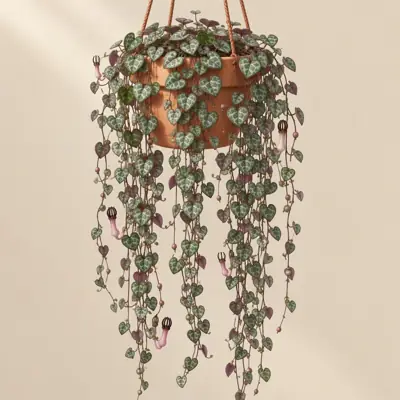
Ceropegia woodii is a perennial evergreen with succulent, slender, trailing vines suited to hanging cultivation; its vines do not climb by twining.
Overview
Ceropegia woodii is a perennial evergreen with succulent, slender, trailing vines suited to hanging cultivation; its vines do not climb by twining.
Origin and habitat
Ceropegia woodii is native to southern Africa, with sources consistently pointing to South Africa and some explicitly including Eswatini and Zimbabwe. Its native habitats include hillsides, and some sources describe it growing in well-drained soils with relatively little moisture and partial sun. It is suited to warm, frost-free conditions and can be grown indoors or as ground cover in warm Mediterranean-type climates.
Characteristics
Mature plants reach 2–10 cm in height, while sources differ on a mature spread of about 200–400 cm. It is reported to grow vigorously under favorable conditions and to fill a pot relatively quickly, with all-green forms generally growing faster than variegated forms. The opposite, succulent, heart-shaped leaves are dark green, often with a silver or gray-silver marbled network; their undersides range from green to purple, and light affects their coloration. The flowers are narrow and tubular to lantern-shaped, with a swollen base and a distinctive lobed structure at the tip, in shades including pink, pale magenta, purple, purplish brown, and creamy white; they are reported to flower most heavily from late summer into autumn and, under suitable conditions, may continue into midwinter, while the fruit consists of horn-like seed pods containing flat seeds with hairy appendages that aid dispersal by air currents.
Light
Sources differ: bright light to partial shade is generally suitable, with bright indirect light indoors, while some sources say acclimated plants with adequate moisture can also tolerate direct sun.
Watering
The growing medium must drain well; after watering, avoid standing water in the pot base or tray and generally water again after the medium has dried. Water can be supplied moderately during active growth, with less water and drier conditions during cooler or non-growing periods.
Temperature and dormancy
Sources differ, with limited evidence suggesting a minimum temperature of about 15 °C. A USDA hardiness-zone classification is reported for the plant, and it is generally frost tender; keep above freezing.
Growing medium and mounting
Ceropegia woodii requires a well-drained growing medium; cactus or succulent potting mix can be used, while RHS lists loamy or sandy soil with an acidic to neutral reaction.
Feeding
Small amounts of fertilizer can be applied during active growth; sources describe using low-nitrogen liquid fertilizer occasionally or diluted general houseplant liquid fertilizer regularly during spring and summer.
Propagation
Ceropegia woodii can be propagated by seed, bead-like aerial tubers formed at stem nodes, or stem cuttings; aerial tubers can root and form new plants after contacting soil.
Common problems
It is reported to be susceptible to mealybugs, aphids, and scale insects, and excessively wet growing medium can lead to basal rot. Overwatering and standing water are major risks; insufficient light can make the foliage paler, while the degree of purple coloration in the leaves also changes with sun exposure. It is cold-sensitive and better suited to warm conditions; in regions with cold winters it is generally grown indoors.
Identification
Ceropegia woodii is distinguished by slender trailing vines with heart-shaped, silver-green patterned leaves; tubers can form at the roots, bead-like aerial tubers commonly develop at stem nodes, and the base of older plants can become woody and form a tuber-like stem base.
Photos


Sources
- Wikipedia (en): Ceropegia woodii — CC BY-SA 4.0 · link
- 維基百科:愛之蔓 — CC BY-SA 4.0 · link
- Wikipedia (ja): ハートカズラ — CC BY-SA 4.0 · link
- Wikipedia (fr): Ceropegia woodii — CC BY-SA 4.0 · link
- Wikipedia (es): Ceropegia woodii — CC BY-SA 4.0 · link
- NC State Plant Toolbox: Ceropegia woodii — copyright (facts only) · link
- LLIFLE Encyclopedia of living forms: Ceropegia woodii — CC BY-SA · link
- RHS Plants: Ceropegia woodii — © RHS, facts only · link
- Top Tropicals catalog: Ceropegia woodii — © Top Tropicals LLC (facts only) · link