
Apple Cactus (Cereus repandus)
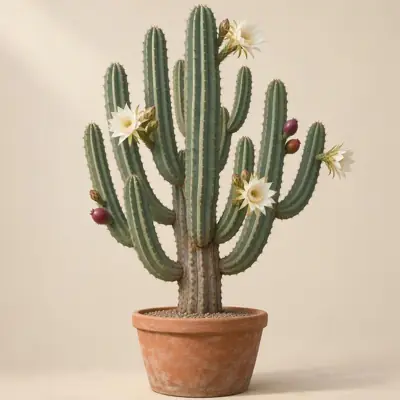
Cereus repandus is a large, upright, columnar succulent cactus that is often shrubby to tree-like, commonly branches, and may develop a distinct main trunk. It is a perennial evergreen stem succulent.
Overview
Cereus repandus is a large, upright, columnar succulent cactus that is often shrubby to tree-like, commonly branches, and may develop a distinct main trunk. It is a perennial evergreen stem succulent.
Origin and habitat
Sources differ on its precise native range, which is centered in northern South America and the Caribbean and includes Colombia, Venezuela, the Netherlands Antilles or ABC islands, and parts of the Windward Islands; long cultivation and escape from cultivation make the natural distribution boundaries difficult to determine. It occurs in tropical seasonally dry and semi-arid environments and in scrub, where it can become a dominant feature of the landscape. Its climate is tropical to subtropical and relatively semi-arid; it withstands high temperatures but has limited frost tolerance.
Characteristics
Sources differ, but mature height is reported at about 800–1200 cm. A single source reports a mature spread of about 10–50 cm. Sources differ in their descriptions of the large, night-opening flowers, which are mainly creamy white to white and typically remain open for only one night; some sources describe reddish tips to the tepals. It is reported to flower in several waves during the warm season.
Light
Cereus repandus takes full sun; indoors it needs bright light, while some horticultural sources also accept full sun to partial sun.
Watering
During active growth, water thoroughly and allow the growing medium to dry before watering again; water can be more plentiful in warm weather, while winter or other non-growing periods call for much less water and near-dry conditions, avoiding overwatering.
Temperature and dormancy
Sources are few and differ, placing the minimum at about -1.1 °C. Sources differ on the reported hardiness classifications. It is generally reported to tolerate brief light frost. It rests cool in winter with a little water.
Growing medium and mounting
It needs a fast-draining cactus mix and is suited to sandy or rocky, rapidly draining soil; horticultural sources differ on soil pH.
Propagation
It can be propagated by seed or stem cuttings, with differing sources recommending sowing or taking cuttings at particular times and stem cuttings from branched plants.
Common problems
It is reported to be susceptible to mealybugs and scale insects. It is generally reported to have few diseases, but overwatering can cause rot and is a principal cultivation problem. It is drought tolerant and withstands high temperatures, but its frost tolerance is limited and freezing should be avoided in cold regions.
Identification
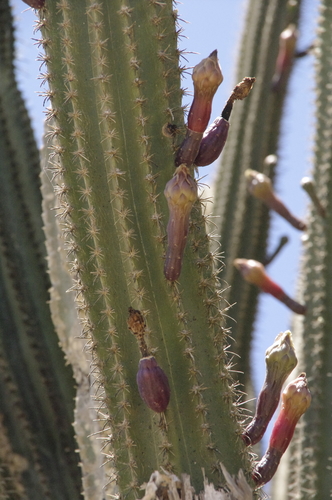
Sources differ in their descriptions, but the stems are cylindrical, gray-green to blue-green, upright or slightly curved, with low, rounded ribs and gray, needle-like, highly variable spines that may be numerous or entirely absent. The plant often has a candelabra-like or tree-like appearance.
Photos



Sources
- Wikipedia (en): Cereus repandus — CC BY-SA 4.0 · link
- Wikipedia (de): Cereus repandus — CC BY-SA 4.0 · link
- Wikipedia (fr): Cereus repandus — CC BY-SA 4.0 · link
- Wikipedia (es): Cereus repandus — CC BY-SA 4.0 · link
- GBIF descriptions: Catálogo de Plantas y Líquenes de Colombia; Chapter 7: Linnaean Plant Names and their Types (part C) — per dataset · link
- Wikipedia (it): Cereus repandus — CC BY-SA 4.0 · link
- Wikipedia (nl): Appelcactus (soort) — CC BY-SA 4.0 · link
- LLIFLE Encyclopedia of living forms: Cereus repandus — CC BY-SA · link
- Useful Tropical/Temperate Plants: Cereus repandus — CC BY-NC-SA 3.0 (facts only) · link
- RHS Plants: Cereus repandus — © RHS, facts only · link
- Desert-Tropicals: Cereus repandus — © Philippe Faucon (desert-tropicals.com), facts only · link
- Top Tropicals catalog: Cereus repandus — © Top Tropicals LLC (facts only) · link
- Cereus Peruvianus: Grow Peruvian Apple Cacti- Epic Gardening (www.epicgardening.com) — facts only (§12) · link