
(Walker's Cattleya (Cattleya walkeriana)
Cattleya walkeriana is a small, strongly creeping epiphytic or lithophytic orchid with pseudobulbs. It is reported to be perennial.
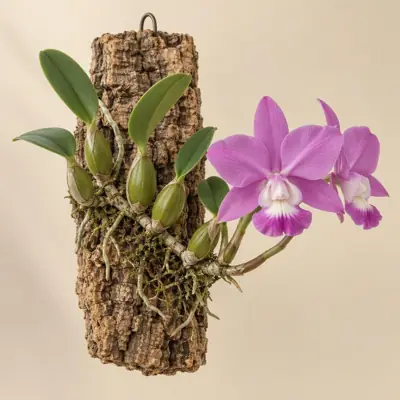
Overview
Cattleya walkeriana is a small, strongly creeping epiphytic or lithophytic orchid with pseudobulbs. It is reported to be perennial.
Origin and habitat
Cattleya walkeriana is native to Brazil, with multiple sources identifying Minas Gerais and Goiás and other sources also recording southern Mato Grosso, São Paulo, and Espírito Santo. It grows on the central Brazilian plateau and in Cerrado-type environments, occurring epiphytically on tree trunks or lithophytically on rocks, often near rivers, lakes, and streams; some plants occur in strongly sunlit sites. A source reports that its native habitat has distinct rainy and dry seasons, with warmer conditions during the rainy period, cooler conditions during the dry period, and frequent morning mist despite limited dry-period rainfall.
Characteristics
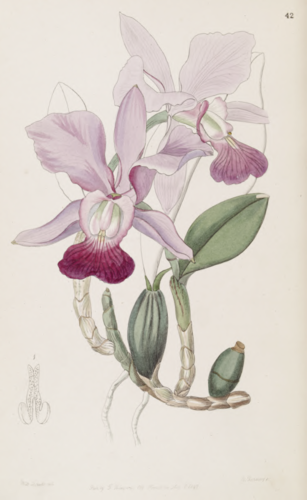
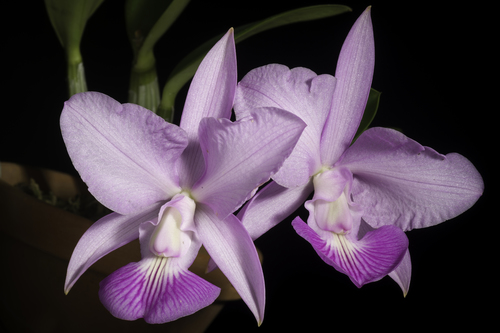
The pseudobulbs usually bear a leaf at the tip and may occasionally bear additional foliage; the leaves are elliptic, ovate to narrowly ovate, thick, and leathery. Sources differ in their descriptions of the flowers: they are large and fragrant, with pink to purplish-red forms often having a whiter center to the lip, as well as white, semi-alba, and bluish-purple color forms; some accounts compare the fragrance to vanilla or cinnamon. Sources also differ on flowering season, with native-habitat and Brazilian cultivation accounts associating the main flowering period with the beginning of the dry season, while other horticultural information describes a different main flowering period and notes that flowering can also occur at other times.
Light
Sources describe Cattleya walkeriana as needing a bright, well-ventilated environment; wild plants can sometimes occur in full sun, while cultivation information recommends strong light while avoiding intense direct sun before acclimation. It is generally described as requiring high light. A specialist source gives a range of about 21530–37700, but sources are few.
Watering
A specialist source reports that water should drain quickly after watering and roots should remain aerated, with greater water needs during active growth and rainy-period conditions and reduced watering during dry-period or winter conditions; it should not be treated as extremely drought-tolerant solely because it comes from the Cerrado. It is generally recommended to let it dry between waterings.
Humidity and airflow
A specialist source gives humidity of about 40–70 %, but sources are few. It is generally reported to prefer high humidity and to need good airflow.
Temperature and dormancy
A source gives an approximate minimum of 10 °C and maximum of 38 °C, but sources are few. A specialist source generally places it in the cool to intermediate temperature group.
Growing medium and mounting
A specialist source reports that Cattleya walkeriana can be grown in a free-draining, well-aerated orchid medium that dries quickly or attached to materials such as bark or cork; sphagnum moss, bark, pine bark, and other epiphytic materials are mentioned, and mounted growth may be preferable. It is epiphytic and is generally reported to prefer being mounted. The medium should not remain waterlogged.
Feeding
Fertilizer can be applied regularly during active growth and reduced or stopped when growth slows; Brazilian information for this species also associates more vigorous new growth with increased watering and feeding.
Propagation
In cultivation, Cattleya walkeriana can be propagated by division, while cultivated collections also contain many plants propagated from seed or meristem culture. The species is sensitive to division, and additional demands on divided plants should be reduced afterward.
Common problems
A source reports that common Cattleya pests include scale insects, thrips, slugs and snails, and false spider mites. A specialist source reports that Cattleya cultivation can be affected by viral disease and that high humidity combined with stagnant air increases the risk of fungal or bacterial problems. Prolonged waterlogging, poor root aeration, and an unsuitable wet-dry cycle can cause growth problems, and Cattleya walkeriana is also sensitive when divided. It can tolerate fairly high summer temperatures, but watering should be reduced during cold periods and cold strong winds avoided; Cattleya generally has relatively low cold tolerance.
Identification
Unlike most Cattleya, its inflorescence can form from the base of a pseudobulb or from a position resembling a new growth rather than typically emerging from the pseudobulb apex; its pseudobulbs are short and globose to shortly spindle-shaped. A Japanese source also describes dimorphism between vegetative and flowering pseudobulbs.
Photos


Sources
- Wikipedia (en): Cattleya walkeriana — CC BY-SA 4.0 · link
- Wikipedia (ja): カトレア・ワルケリアナ — CC BY-SA 4.0 · link
- Wikipedia (pt): Cattleya walkeriana — CC BY-SA 4.0 · link
- Internet Orchid Species Photo Encyclopedia: Cattleya walkeriana — © Jay Pfahl / IOSPE contributors, facts only · link
- AOS culture sheet: Cattleya (genus-level) — © American Orchid Society, facts only · link
- NHK みんなの趣味の園芸 植物図鑑: Cattleya (genus-level) — © NHK出版, facts only · link
- NC State Plant Toolbox: Cattleya (genus-level) — copyright (facts only) · link