
Cattleya hybrid (Cattleya hybrid)
Sources differ in describing Cattleya hybrida as primarily epiphytic, with a rhizome and upright pseudobulbs, while some Cattleya can also be terrestrial. It is reported to be a perennial herb.
Overview
Sources differ in describing Cattleya hybrida as primarily epiphytic, with a rhizome and upright pseudobulbs, while some Cattleya can also be terrestrial. It is reported to be a perennial herb.
Origin and habitat
The Cattleya groups to which its parents belong are reported to be native to tropical parts of the Americas, extending from Costa Rica south to Argentina, while horticultural sources also describe their range more broadly as Central and South America. The parental groups are generally epiphytic on trees and other supports, with roots adapted to drying quickly after becoming wet, although Cattleya also includes terrestrial forms. They are reported from tropical to subtropical environments.
Characteristics
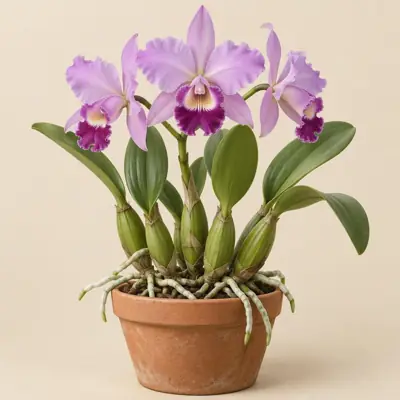
Few sources report a mature height of about 20–60 cm. Pseudobulbs are generally topped by leaves that are thick and slightly fleshy to leathery, with oblong, lanceolate, or elliptic shapes and smooth margins. Flowers generally form near the tops of the pseudobulbs and vary in color; the lip often contrasts with the other floral segments in color and form, and many plants are fragrant. Flowering time is reported to vary by cultivar, with different types collectively flowering across the year, and the fruit is reported to be a capsule containing many small seeds.
Light
Sources differ on light guidance, but describe a bright, well-lit environment with shade from intense sunlight, especially direct midday sun, together with good airflow. It is generally described as requiring high light.
Watering
It is generally recommended to water thoroughly after the medium dries and to avoid prolonged wetness, with more water during active growth, drier management from late autumn through winter, and enough water while flower buds are elongating. It is generally best to let it dry between waterings.
Humidity and airflow
Sources differ on humidity, giving a range of about 40–70 %. It generally prefers moderate humidity and needs good airflow.
Temperature and dormancy
Sources differ on the lower temperature guidance, while specialist sources describe a moderate ideal temperature range and greater heat tolerance. It is reported to be frost tender; keep above freezing.
Growing medium and mounting
A fast-drying, well-drained and airy orchid medium is generally recommended, using materials such as bark, sphagnum moss, or coconut husk; bark media indoors may include some sphagnum moss, while mature plants generally use coarser media. It is generally epiphytic, has aerial roots with velamen, and favors bark as a growing medium.
Feeding
During vigorous growth, it is generally fed regularly with diluted fertilizer and may receive a higher-nitrogen formula; feeding is reduced as growth slows in autumn or stopped in winter.
Propagation
In home cultivation, propagation is generally by division, retaining several healthy pseudobulbs in each division; propagation from seed or tissue culture is also possible.
Common problems
Scale insects are reported as common, with Boisduval scale, hemispherical scale, greenhouse thrips, slugs, snails, and false spider mites also recorded. Viral diseases are reported to pose a risk, causing irregular spotting of flowers and leaves and weakening plants, while high humidity with stagnant air can increase the risk of fungal or bacterial disease. Prolonged wetness or poor drainage generally conflicts with the roots' wet-dry cycle; insufficient light can hinder flowering, while intense direct light can scorch leaves. It is generally less tolerant of cold and more tolerant of heat; cold water may damage the plant, while hot conditions call for increased humidity, water, airflow, and shade.
Identification
Cattleya hybrida generally has a creeping rhizome, thick fleshy roots, upright water-storing pseudobulbs topped by thick leaves, and flowers with a conspicuous lip.
Sources
- Wikipedia (en, genus): Cattleya — CC BY-SA 4.0 · link
- AOS culture sheet: Cattleya (genus-level) — © American Orchid Society, facts only · link
- NHK みんなの趣味の園芸 植物図鑑: Cattleya (genus-level) — © NHK出版, facts only · link
- NC State Plant Toolbox: Cattleya (genus-level) — copyright (facts only) · link
- Cattleyas-Revised-2020.pdf (secure.aos.org) — facts only (§12) · link