
Madagascar Periwinkle (Catharanthus roseus)
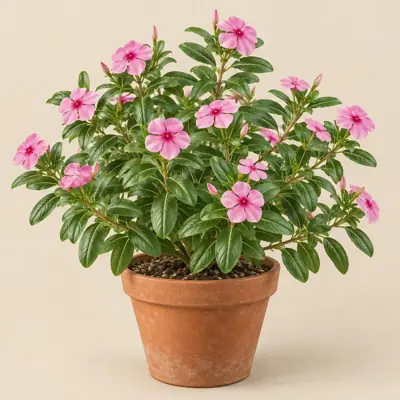
Catharanthus roseus is an evergreen perennial herb to subshrub with an upright, spreading, or trailing habit, and its stem base may become woody; cultivated varieties are often upright or compactly branched. Sources differ in describing its cultivation as a perennial or seasonal annual: it can be grown as a perennial in tropical climates, while in colder temperate regions it is usually grown as an annual seasonal flowering plant.
Overview
Catharanthus roseus is an evergreen perennial herb to subshrub with an upright, spreading, or trailing habit, and its stem base may become woody; cultivated varieties are often upright or compactly branched. Sources differ in describing its cultivation as a perennial or seasonal annual: it can be grown as a perennial in tropical climates, while in colder temperate regions it is usually grown as an annual seasonal flowering plant.
Origin and habitat
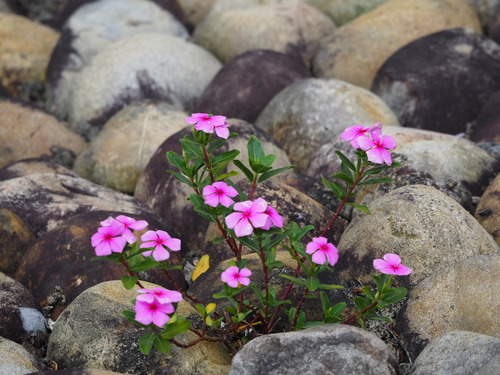
Sources differ somewhat on its status in Madagascar, with most describing Catharanthus roseus as native or endemic there. Natural habitats include dry coasts and sandy ground in Madagascar, as well as riverbanks, savannas, dry wasteland, roadsides, and some open woodland or scrub; it can also reproduce in disturbed habitats. It is adapted to tropical and subtropical climates and can also be grown as a warm-season annual in warm-temperate climates; it is widely cultivated and naturalized in tropical and subtropical regions worldwide.
Characteristics
Sources differ on mature size, placing height at about 30–100 cm, while a single source reports a spread of about 10–50 cm. It is reported to grow rapidly and to have opposite, simple, entire leaves that are mainly ovate to oblong, green to glossy dark green, often with a paler midrib. The flowers have a salver-shaped corolla with a slender tube and spreading lobes, commonly in white, pink, red, magenta, or purple, sometimes with a differently colored center; sources differ on flowering periods, but describe sustained flowering mainly during warm seasons. The fruit is reported to consist usually of paired, narrow follicles containing many seeds when mature.
Light
Full sun is best, though partial sun or partial shade is tolerated; cultivated plants benefit from ample light.
Watering
The growing medium should drain well; water moderately during growth, though the plant has some drought tolerance, and cultivation guidance from Taiwan recommends watering after the medium dries or the leaves become slightly wilted and reducing water in winter.
Humidity and airflow
It is reported to need good airflow.
Temperature and dormancy
A minimum temperature of 5 °C is given for cultivation. Sources differ on the ideal temperature, placing it at about 20–30 °C, while a single source reports an upper temperature of about 35 °C. Sources differ on hardiness, describing perennial cultivation in warmer zones and annual cultivation in colder regions. It is generally described as frost tender and should be kept above freezing.
Growing medium and mounting
Catharanthus roseus needs a well-drained growing medium or soil and can adapt to loam, sand, and chalky soil, tolerate a relatively broad range of soil acidity and alkalinity, and withstand some nutrient-poor conditions.
Feeding
A balanced liquid fertilizer is reported to be suitable for regular application during active growth.
Propagation
It can be propagated from seed or cuttings; seed can be sown under warm conditions in early spring, softwood cuttings can be taken in late spring, and semi-hardwood cuttings in summer. New cuttings should initially be kept moist enough to avoid wilting.
Common problems
Horticultural sources list southern bacterial wilt, Phytophthora blight and root rot, and black root rot as disease problems, while Taiwan sources also note a risk of Rhizoctonia damping-off. A single source reports that overly wet growing medium or temperatures that are too low can cause yellowing or death, while poor drainage and soil splashed by rain can increase disease risk. The plant tolerates high temperatures and some drought but is sensitive to low temperatures and frost, which can cause shoots or the entire plant to die.
Identification
Key visible features include opposite paired leaves with a conspicuous pale midrib and flowers with a slender corolla tube and spreading lobes; the plant may contain white milky sap.
Photos


Sources
- GBIF Backbone: Catharanthus roseus (L.) G.Don — CC BY 4.0 · link
- Wikipedia (en): Catharanthus roseus — CC BY-SA 4.0 · link
- 維基百科:長春花 — CC BY-SA 4.0 · link
- Wikipedia (ja): ニチニチソウ — CC BY-SA 4.0 · link
- Wikipedia (de): Rosafarbene Catharanthe — CC BY-SA 4.0 · link
- Wikipedia (fr): Pervenche de Madagascar — CC BY-SA 4.0 · link
- Wikipedia (es): Catharanthus roseus — CC BY-SA 4.0 · link
- GBIF descriptions: The checklist of alien seed plants of D.R. Congo, based on evidence from herbarium collections; Chec — per dataset · link
- NC State Plant Toolbox: Catharanthus roseus — copyright (facts only) · link
- Wikipedia (it): Catharanthus roseus — CC BY-SA 4.0 · link
- Wikipedia (nl): Roze maagdenpalm — CC BY-SA 4.0 · link
- Useful Tropical/Temperate Plants: Catharanthus roseus — CC BY-NC-SA 3.0 (facts only) · link
- RHS Plants: Catharanthus roseus — © RHS, facts only · link
- USDA PLANTS Database: Catharanthus roseus — Public domain (US Government work) · link