
Burmese fishtail palm (Caryota mitis)
Caryota mitis is an evergreen, clumping palm that usually produces multiple unbranched stems from the base, although some accounts describe it as single-stemmed. It is a perennial evergreen palm; each stem dies after completing its flowering and fruiting cycle, while the clump can continue renewing itself through new basal stems.
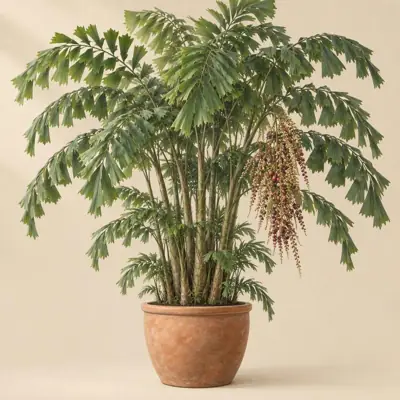
Overview
Caryota mitis is an evergreen, clumping palm that usually produces multiple unbranched stems from the base, although some accounts describe it as single-stemmed. It is a perennial evergreen palm; each stem dies after completing its flowering and fruiting cycle, while the clump can continue renewing itself through new basal stems.
Origin and habitat
Sources differ on the native range: its core distribution is described as extending from southern China and Indochina to the Malay Archipelago, while some accounts also include Myanmar, Bangladesh, India, and the Philippines; it is now cultivated in other tropical regions and has become naturalized in Florida and parts of Africa and Latin America. It occurs in tropical rainforests, valley forests of southern China, and moist, organic-rich woodland that may occur on limestone, as well as in disturbed woodland. It favors warm tropical to warm-temperate conditions and is suited to high-rainfall tropical regions, with low cold tolerance.
Characteristics
Sources differ on mature height, placing it at about 400–1500 cm, while mature spread is 250–400 cm. The large, long-stalked, arching leaves of mature plants are mainly bipinnate, with fan-shaped to fishtail-shaped leaflets whose truncate tips have irregular teeth or torn-looking divisions. The flowers are small and borne on drooping or large inflorescences; sources differ in describing their color as creamy white, pale yellow, pale red, or purple, and flowering occurs in summer. The fruit is nearly spherical and fleshy, becoming red, dark purplish red, or black when mature.
Light
Sources differ on light conditions, describing cultivation in shade, bright indirect light, or full sun, with bright filtered light also used in greenhouse cultivation.
Watering
During active growth, maintain moderate moisture without waterlogging; cultivation guidance includes keeping the medium moist but well drained, reducing watering in winter, or waiting for the medium to dry before watering again.
Growing medium and mounting
Suitable media include loamy or sandy conditions that are moist but well drained; cultivation is recorded under acidic, neutral, and alkaline conditions, while containers may use nutrient-rich or loam-based media.
Feeding
A balanced liquid fertilizer can be applied regularly during the growing period.
Propagation
Caryota mitis can be propagated by seed, and one source recommends sowing in spring.
Common problems
Reported pests include greenhouse thrips, root mealybugs, and fern scale. One source reports susceptibility to Lethal Yellowing. Indoor cultivation information also notes that leaf tips may turn yellow. Cold tolerance is low; although slight frost can be tolerated, this is not a cold-hardy plant, and its relatively shallow roots make strong winds undesirable, favoring a more sheltered position.
Identification
Key identifying features are the clumping stems arising from the base, fishtail-shaped leaflets with irregularly divided or toothed tips, and ring-shaped leaf scars visible on the stems.
Photos


Sources
- Wikipedia (en): Caryota mitis — CC BY-SA 4.0 · link
- 維基百科:短穗鱼尾葵 — CC BY-SA 4.0 · link
- Wikipedia (ja): コモチクジャクヤシ — CC BY-SA 4.0 · link
- Wikipedia (de): Caryota mitis — CC BY-SA 4.0 · link
- Wikipedia (fr): Caryota mitis — CC BY-SA 4.0 · link
- Wikipedia (es): Caryota mitis — CC BY-SA 4.0 · link
- GBIF descriptions: Lista de especies de plantas exóticas y trasplantadas de Colombia; Catálogo de Plantas y Líquenes de — per dataset · link
- NC State Plant Toolbox: Caryota mitis — copyright (facts only) · link
- TaiCOL 臺灣物種名錄: Caryota mitis — CC BY 4.0 · link
- Useful Tropical/Temperate Plants: Caryota mitis — CC BY-NC-SA 3.0 (facts only) · link
- RHS Plants: Caryota mitis — © RHS, facts only · link
- USDA PLANTS Database: Caryota mitis — Public domain (US Government work) · link