
cayenne pepper (Capsicum annuum)
Capsicum annuum is a highly branched herbaceous to shrubby plant whose base may become woody, with an upright or spreading habit. Sources differ on its life cycle: it can be perennial by nature but is often grown as an annual in temperate and general cultivation conditions, and it is not tolerant of frost.
Overview
Capsicum annuum is a highly branched herbaceous to shrubby plant whose base may become woody, with an upright or spreading habit. Sources differ on its life cycle: it can be perennial by nature but is often grown as an annual in temperate and general cultivation conditions, and it is not tolerant of frost.
Origin and habitat
Sources differ on the exact boundaries of its native range, but broadly place it in the Americas, encompassing Mexico, Central America, northern South America, and southern North America. Sources differ regarding its original wild habitat; it is now widely cultivated around the world. It is suited to warm climates and is widely cultivated from warm-temperate to tropical conditions; it may be grown as a perennial in lowland tropical areas and is often grown as an annual in warm-temperate and subtropical areas.
Characteristics
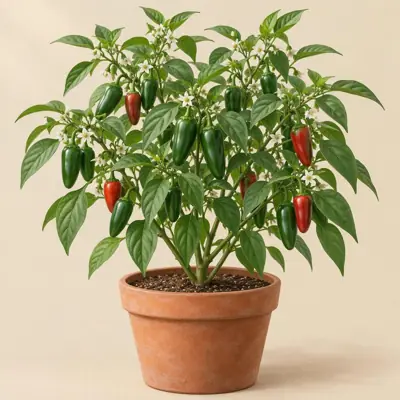
Sources differ, placing mature height at about 50–200 cm; the few available sources report a mature spread of about 10–50 cm. The simple, alternate leaves are generally ovate to ovate-lanceolate, with pointed tips, entire margins, and usually green coloration. Flowers are usually white and solitary, with several petals, although some may have purple coloration or markings; a single source reports a defined flowering period. The fruit is a many-seeded berry that varies greatly among cultivars in shape, size, and pungency; immature fruit is often green and may become red, yellow, orange, purple, or white when mature, while Jalapeño has a reported pungency range.
Light
Capsicum annuum grows in full sun in a warm, sheltered position.
Watering
Water regularly, keeping the growing medium moist but well drained and allowing the surface to dry slightly before watering again; excessive rainfall may reduce flowering and fruit set and increase disease.
Temperature and dormancy
The few available sources report a minimum of about -1.1 °C, an ideal range of about 21–25 °C, and a maximum of about 32 °C. Sources differ on the reported hardiness zone. Capsicum annuum tolerates brief light frost.
Growing medium and mounting
Fertile, humus-rich, well-drained loam or sandy soil is suitable, with slightly acidic to neutral conditions preferred; sources also report a preferred and a broader tolerated acidity range.
Propagation
A single source reports that Capsicum annuum can be propagated from seed, with seedlings started indoors before the last frost and later transplanted outdoors.
Common problems
Reported pests include aphids, caterpillars, European pepper moth, silverleaf whitefly, and greenhouse whitefly. Reported diseases include southern bacterial wilt, Phytophthora blight, southern blight, pepper anthracnose, and bacterial spot of pepper and tomato. Blossom-end rot may occur, while excessive rainfall may reduce flowering and fruit set and promote disease. The plant is sensitive to frost and requires consistently warm growing conditions; mature plants tolerate only brief light frost, while young plants need greater protection from low temperatures.
Identification
Cultivated forms of Capsicum annuum show very broad variation in fruit shape, color, size, and capsaicin expression, with the species encompassing sweet peppers and many types of chili pepper; Jalapeño is among its pungent types.
Photos


Sources
- Wikipedia (en): Capsicum annuum — CC BY-SA 4.0 · link
- 維基百科:一年生辣椒 — CC BY-SA 4.0 · link
- Wikipedia (ja): トウガラシ — CC BY-SA 4.0 · link
- Wikipedia (de): Spanischer Pfeffer — CC BY-SA 4.0 · link
- Wikipedia (fr): Capsicum annuum — CC BY-SA 4.0 · link
- Wikipedia (es): Capsicum annuum — CC BY-SA 4.0 · link
- GBIF descriptions: Manual of the Alien Plants of Belgium; The checklist of alien seed plants of D.R. Congo, based on ev — per dataset · link
- NC State Plant Toolbox: Capsicum annuum — copyright (facts only) · link
- Wikipedia (it): Capsicum annuum — CC BY-SA 4.0 · link
- Wikipedia (pt): Capsicum annuum — CC BY-SA 4.0 · link
- Wikipedia (ko): 고추 (종) — CC BY-SA 4.0 · link
- TaiCOL 臺灣物種名錄: Capsicum annuum — CC BY 4.0 · link
- Useful Tropical/Temperate Plants: Capsicum annuum — CC BY-NC-SA 3.0 (facts only) · link
- RHS Plants: Capsicum annuum — © RHS, facts only · link