
Indian shot (Canna indica)
Canna indica is a perennial herb that grows in clumps, with upright stems and thick, branching underground rhizomes.
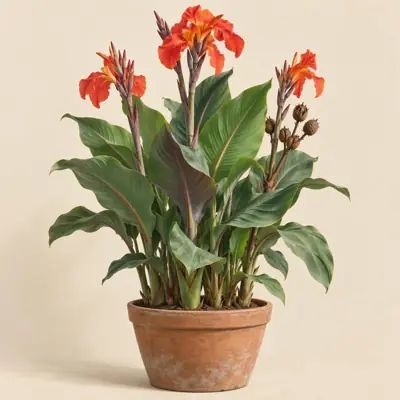
Overview
Canna indica is a perennial herb that grows in clumps, with upright stems and thick, branching underground rhizomes.
Origin and habitat
Sources differ on its native range: it is native to the Americas, chiefly tropical America and the Neotropics, including the Caribbean, Central America, and South America, while some sources also include Mexico and the southern United States. It commonly occurs in moist to wet sites, along streams, in scrub, secondary vegetation, disturbed areas, roadsides, and around villages, and it can also invade cultivated land. It is suited to tropical, subtropical, and warm-temperate environments, preferring a warm, humid climate, and can escape cultivation or become naturalized in many frost-free areas.
Characteristics
Sources differ on mature height, placing it at about 50–300 cm, while a single source reports a mature spread of about 10–50 cm. The large, simple leaves are alternate and may be arranged spirally or in ranks; they have short petioles, are generally elliptic to oblong and green to purplish green, with veins extending outward from the midrib. The terminal racemes bear bisexual flowers commonly in red, yellow, or orange, while horticultural sources also record pink and rosy pink; the conspicuous petal-like structures are formed mainly from petaloid stamens. Sources differ on flowering season, describing flowering mainly from summer into autumn and, in tropical regions, throughout the year; the fruit is an elliptic to spherical capsule with a warty or softly spiny surface that may mature from brown to black and contains hard, round, black seeds, and a single source reports rapid growth.
Light
Full sun is preferred, though it can also grow in partial sun, and ample sunlight favors flowering.
Watering
It prefers moist conditions and steady moisture during growth; moist but well-drained soil is suitable, dry sites require supplemental watering, while some cultivation sources also recommend watering after the surface soil has dried slightly.
Humidity and airflow
It needs little air movement.
Temperature and dormancy
A single source reports a minimum temperature of about -1.1 °C and an ideal temperature range of about 12–32 °C, so sources are few for these temperature figures. Sources differ in their hardiness classifications, while cross-source evidence indicates that it tolerates brief light frost.
Growing medium and mounting
Sources differ in their descriptions of suitable soil, but favor moist loam that is rich in organic matter, fertile, relatively deep, and well drained; it can also grow in sandy, clay, loamy, and chalky soils across a relatively broad pH range.
Feeding
A high-potassium fertilizer can be applied regularly during the growing season, and compost mulch or additional fertilizer can be applied after pruning in late winter or early spring to encourage new growth.
Propagation
It can be propagated by seed or division; the hard seed coat can be scarified and the seeds soaked, while division involves cutting healthy underground rhizomes with buds and replanting them.
Common problems
Dry conditions require attention to water supply, and the large leaves are readily affected by strong winds. It is frost-sensitive, and even light frost can damage or kill back above-ground growth; in colder areas, a sheltered position and frost-free overwintering of the rhizomes are recommended.
Identification
Canna indica can be recognized by its large banana-like leaves, thick branching underground rhizomes, conspicuous floral structures formed from petaloid stamens, and black, round, hard seeds.
Photos


Sources
- Wikipedia (en): Canna indica — CC BY-SA 4.0 · link
- 維基百科:美人蕉 — CC BY-SA 4.0 · link
- Wikipedia (ja): ダンドク — CC BY-SA 4.0 · link
- Wikipedia (de): Indisches Blumenrohr — CC BY-SA 4.0 · link
- Wikipedia (fr): Canna indica — CC BY-SA 4.0 · link
- Wikipedia (es): Canna indica — CC BY-SA 4.0 · link
- GBIF descriptions: The checklist of alien seed plants of D.R. Congo, based on evidence from herbarium collections; Chec — per dataset · link
- NC State Plant Toolbox: Canna indica — copyright (facts only) · link
- Wikipedia (it): Canna indica — CC BY-SA 4.0 · link
- 農業知識入口網 植物圖鑑: Canna indica — © MOA, facts only · link
- Useful Tropical/Temperate Plants: Canna indica — CC BY-NC-SA 3.0 (facts only) · link
- RHS Plants: Canna indica — © RHS, facts only · link
- USDA PLANTS Database: Canna indica — Public domain (US Government work) · link
- Top Tropicals catalog: Canna indica — © Top Tropicals LLC (facts only) · link