
creeping inchplant (Callisia repens)
Callisia repens is a perennial evergreen succulent herb with creeping, mat-forming or trailing growth, and its stem nodes root readily when they contact the ground.
Overview
Callisia repens is a perennial evergreen succulent herb with creeping, mat-forming or trailing growth, and its stem nodes root readily when they contact the ground.
Origin and habitat
It is native to the Americas, from the southern United States to Argentina, including the West Indies, with records specifically mentioning Texas, Florida, Guadeloupe and Martinique. It occurs mainly in shaded, rocky or gravelly settings in tropical to subtropical forests or scrub, and is also recorded from moist, lowland, shaded habitats in South America. It is a tropical to subtropical plant that does not tolerate frost and needs to be moved indoors for winter in cold regions.
Characteristics
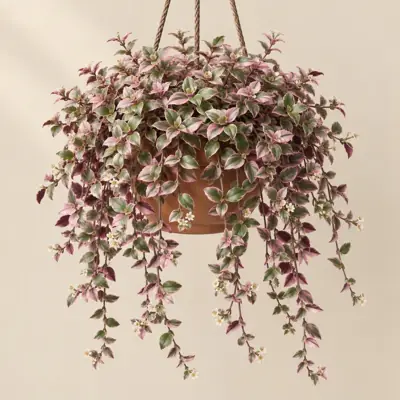
Mature plants reach 10–50 cm in height and spread 50–100 cm. Growth is rapid, with creeping stems rooting readily at their nodes and quickly forming ground cover; the small, succulent and relatively tender leaves are ovate to lanceolate, become smaller toward the shoot tips, and may be green, pink, golden yellow, white or variegated depending on the cultivated form. Sources describe the flowers differently: they are small and white or pink, with inflorescences arising from distal leaf axils on flowering shoots, and the white perianth segments are lanceolate. Flowering occurs from late spring through summer, and the fruit is a capsule containing seeds.
Light
Sources describe this differently: Callisia repens grows in bright indirect light to partial shade; strong light can redden the foliage, while intense direct sunlight may cause discoloration or scorch.
Watering
During the growing season, keep it moderately moist and water more generously while ensuring the growing medium drains well; overwatering may lead to root rot or fungal disease.
Temperature and dormancy
Sources differ, with limited evidence suggesting a minimum temperature of about 10 °C. The ideal temperature is 18–22 °C.
Growing medium and mounting
Use a well-drained growing medium, such as sandy soil or potting medium containing perlite; it can also adapt to chalk, loam and sand, and to acidic, neutral or alkaline conditions.
Feeding
It is reported to benefit from liquid fertilizer during the growing season.
Propagation
It can be propagated from stem cuttings, and stem nodes root readily on their own; division, rooted side shoots and seed are also recorded propagation methods.
Common problems
Sources differ on pest problems, with snails, spider mites, aphids and mealybugs reported as possible pests. Overwatering is reported to increase the risk of root rot or fungal disease, while intense direct sunlight may cause discoloration or sun scorch and insufficient light may produce elongated, weak stems. It does not tolerate frost and needs to be moved indoors for winter in colder climates; outdoor overwintering is recommended only under sufficiently warm conditions.
Identification
Callisia repens is low and dense, with small succulent leaves and a creeping or trailing habit; its stem nodes root very readily to form mats, and it may have purple stems, while cultivated forms may show pink, golden yellow, white or other variegation.
Photos


Sources
- Wikipedia (en): Callisia repens — CC BY-SA 4.0 · link
- Wikipedia (de): Kriechendes Schönpolster — CC BY-SA 4.0 · link
- Wikipedia (fr): Callisie rampante — CC BY-SA 4.0 · link
- GBIF descriptions: Catálogo de Plantas y Líquenes de Colombia; Chapter 7: Linnaean Plant Names and their Types (part C) — per dataset · link
- NC State Plant Toolbox: Callisia repens — copyright (facts only) · link
- RHS Plants: Callisia repens — © RHS, facts only · link
- USDA PLANTS Database: Callisia repens — Public domain (US Government work) · link