
million bells (Calibrachoa hybrid)
Calibrachoa is reported to be a low-growing, trailing herb or small shrub or subshrub whose stems can become woody. It is reported to be an evergreen, short-lived perennial that may also behave as an annual or perennial, and in cultivation it is often treated as a half-hardy annual.
Overview
Calibrachoa is reported to be a low-growing, trailing herb or small shrub or subshrub whose stems can become woody. It is reported to be an evergreen, short-lived perennial that may also behave as an annual or perennial, and in cultivation it is often treated as a half-hardy annual.
Origin and habitat
Calibrachoa is reported to be native to South America, with a range extending from southern Brazil to Peru and Chile. Its reported habitats include scrub and open grassland.
Characteristics
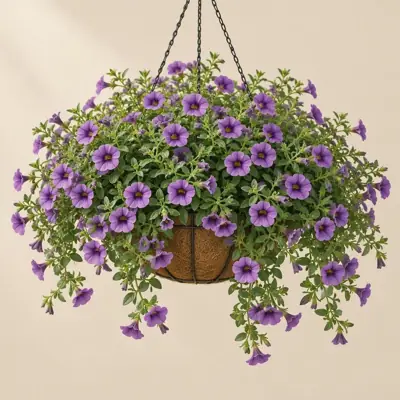
The leaves are reported to be ovate, elliptic, obovate, or linear, with margins that are flat or rolled back. The flowers are reported to be small and petunia-like, usually bilaterally symmetrical, with mostly funnel-shaped corollas that may be purple, red, pink, or nearly white; Calibrachoa pygmaea is an exception in flower form. The fruit is reported to be a capsule, and the seeds have a net-like surface pattern.
Light
Calibrachoa is generally grown in full sun to partial sun.
Watering
Calibrachoa generally does best in well-drained soil and is watered when the soil is nearly dry.
Temperature and dormancy
Calibrachoa is reported to tolerate brief light frost.
Propagation
Calibrachoa is reported to be propagated from stem-tip cuttings and is also often cultivated as a half-hardy annual.
Common problems
Calibrachoa is reported to tolerate light frost.
Identification
Calibrachoa is reported to be low-growing and trailing, with small petunia-like flowers; it is closely related to Petunia but has important differences in chromosomes, external morphology, and features associated with fertilization.
Sources
- Wikipedia (en): Calibrachoa — CC BY-SA 4.0 · link