
Calibanus hookeri (Calibanus hookeri)
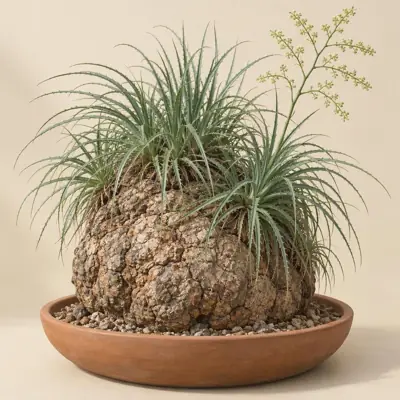
Calibanus hookeri is reported to be a perennial succulent with a large woody caudex and multiple leaf rosettes arising from its top. Individual leaf rosettes are reported to function as independent units formed through vegetative propagation, dying after fruiting and being replaced by new rosettes.
Overview
Calibanus hookeri is reported to be a perennial succulent with a large woody caudex and multiple leaf rosettes arising from its top. Individual leaf rosettes are reported to function as independent units formed through vegetative propagation, dying after fruiting and being replaced by new rosettes.
Origin and habitat
Sources differ on its recorded range in central to northeastern Mexico: records include Hidalgo, San Luis Potosí, and Tamaulipas, while another source also records Querétaro. It is reported from dry mountainous areas and desert and semi-desert scrub in central Mexico, including gravelly environments, with more water available during a brief growing period. It is reported to occur in dry to semi-dry climates and to be highly drought tolerant.
Characteristics
The leaves are reported to be linear, slender and grass-like, rough and tough in texture, and blue-green to gray-green; they form multiple dense tufts from the caudex, and mature leaves may curve outward and droop. Sources differ in their descriptions of the very small flowers, which occur on branched inflorescences and are recorded as greenish white, creamy white, pale green, pink, or purple; plants are usually described as having male and female flowers on separate individuals, though some may have both sexes. Sources differ in their descriptions of the nearly spherical to ovoid fruit, which matures from straw-brown to reddish brown and contains seeds; sources also differ on mature spread, reported at about 30–100 cm, while a single source reports mature height at about 25–80 cm. The caudex is described by a specialist source as a swollen root, and supported specialist information describes it as large, with substantially greater sizes possible in the wild.
Light
It is reported to grow mainly in full sun and can also be cultivated in bright, lightly shaded conditions.
Watering
It is reported to need moderate watering during active growth and little water at other times; established plants are highly drought tolerant, and the growing medium should not remain waterlogged. A specialist source recommends watering sparingly while leafless.
Humidity and airflow
Specialist sources report that it prefers low humidity and needs good airflow.
Temperature and dormancy
Sources differ on its lower temperature tolerance, with a reported minimum of about -8 °C, while a specialist source gives about -15 °C. Specialist information describes it as frost hardy.
Growing medium and mounting
For container cultivation, it is reported to favor a porous, well-drained medium that may include pumice, volcanic rock, and perlite; a source reports better performance in a somewhat acidic medium and says fertilized potting medium may be used. Specialist information indicates that it needs a fast-draining mix.
Feeding
A source reports that a fertilized growing medium may be used.
Propagation
A specialist source reports propagation by seed.
Common problems
It is reported to be drought tolerant, while records of cold tolerance vary considerably; more conservative information describes only brief tolerance of cold under dry conditions.
Identification
It is reported to have a low, spherical to flattened-spherical large woody caudex with a cracked or corky surface, densely topped by slender, grass-like blue-green leaves; large wild plants may resemble grass-covered rocks.
Photos


Sources
- GBIF Backbone: Calibanus hookeri (Lem.) Trel. — CC BY 4.0 · link
- Wikipedia (en): Calibanus hookeri — CC BY-SA 4.0 · link
- Wikipedia (de): Calibanus hookeri — CC BY-SA 4.0 · link
- Wikipedia (es): Calibanus hookeri — CC BY-SA 4.0 · link
- LLIFLE Encyclopedia of living forms: Calibanus hookeri — CC BY-SA · link
- PUKUBOOK: Calibanus hookeri — CC BY-NC (facts only) · link