
heart of Jesus (Caladium bicolor)
Caladium bicolor is a herbaceous foliage plant with no obvious above-ground stem, with leaf stalks arising from an underground tuber. It is a perennial herb with seasonal dormancy and is often grown as a summer annual in temperate horticulture.
Overview
Caladium bicolor is a herbaceous foliage plant with no obvious above-ground stem, with leaf stalks arising from an underground tuber. It is a perennial herb with seasonal dormancy and is often grown as a summer annual in temperate horticulture.
Origin and habitat
Sources differ on its native range, but describe Caladium bicolor as native to tropical America, principally Central and South America, with accounts extending from Mexico, Central America, and Panama south through Brazil, Bolivia, Peru, Colombia, Venezuela, and Guyana and into northern Argentina and eastern Brazil. It occurs in moist, partly shaded settings in tropical forests and along forest edges, often in fertile, organic-rich, well-drained soil. It is associated with warm, relatively humid tropical to subtropical climates; during active growth it does not tolerate dry conditions and is sensitive to frost and low temperatures.
Characteristics
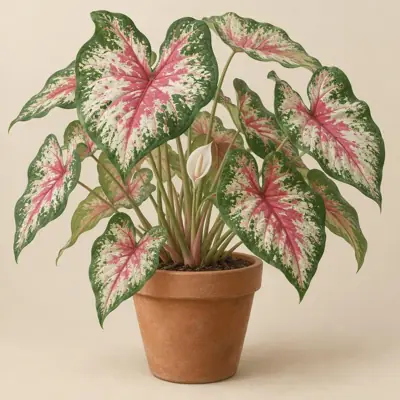
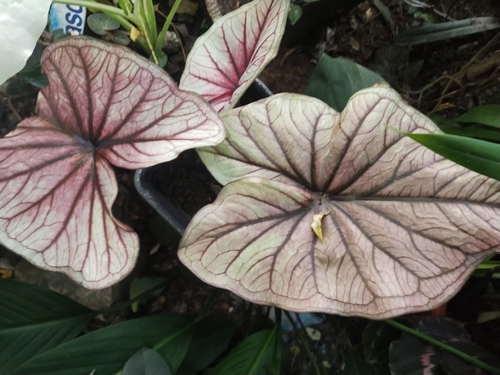
Sources differ, with a mature height reported at about 40–80 cm. The large leaves are often heart-shaped, semi-heart-shaped, arrow-shaped, or lance-shaped, with green, white, pink, and red mottling, stripes, veins, or marginal patches; long leaf stalks arise directly from near the underground tuber. The inflorescence has the typical aroid spathe and spadix and may be white or greenish white; it flowers in summer, and its ornamental value is generally lower than that of the foliage. It produces fruit, but the fruit has little horticultural ornamental value.
Light
Sources differ on light: depending on the cultivar and growing environment, it can be grown in bright indirect light, partial sun, or sunny conditions; several sources recommend partial sun, bright shade, or filtered sunlight, while some horticultural sources recommend full sun. It is reported to tolerate some direct sun; acclimation to strong light should be gradual to reduce the risk of leaf injury or scorching.
Watering
During active growth, keep the soil evenly moist and water regularly while maintaining good drainage and avoiding waterlogging; as dormancy begins in autumn and winter, gradually reduce watering and keep conditions drier during dormancy.
Humidity and airflow
It is reported to prefer high humidity and to need little air movement.
Temperature and dormancy
A single source reports a minimum temperature of about 1.7 °C, so sources are few. Sources differ on its hardiness-zone classification. It is reported to be frost tender; keep above freezing.
Growing medium and mounting
Grow it in fertile, loose, humus- or organic-rich, well-drained soil, with a preference for slightly acidic to acidic conditions; the medium should remain moderately moist without becoming waterlogged. It has tuberous roots and is generally reported to favor an airy mix.
Feeding
Fertilize periodically during active growth and stop feeding after dormancy begins.
Propagation
Propagate by dividing or cutting the tuber, usually during dormancy or when replanting in spring, retaining buds on each division.
Common problems
Possible pests include slugs, snails, spider mites, and greenhouse whiteflies. Southern blight may occur, although NC State reports that serious common pest and disease problems are generally absent. Excessive dryness during active growth can impair growth, while prolonged cold and wet conditions around the roots can cause tuber failure or rot; sudden changes in sun exposure or excessively strong direct light can injure or scorch leaves under some conditions. Frost and low temperatures are damaging, and strong winds and hail can injure the fragile leaves.
Identification
Key identifying features are an underground tuber, no obvious above-ground stem, upright long leaf stalks, and heart-shaped to arrow-shaped leaves with strongly contrasting green, white, pink, and red markings.
Photos
Sources
- GBIF Backbone: Caladium bicolor (Aiton) Vent. — CC BY 4.0 · link
- Wikipedia (en): Caladium bicolor — CC BY-SA 4.0 · link
- 維基百科:五彩芋 — CC BY-SA 4.0 · link
- Wikipedia (fr): Caladium bicolor — CC BY-SA 4.0 · link
- Wikipedia (es): Caladium bicolor — CC BY-SA 4.0 · link
- NC State Plant Toolbox: Caladium bicolor — copyright (facts only) · link
- Wikipedia (pt): Tinhorão — CC BY-SA 4.0 · link
- Useful Tropical/Temperate Plants: Caladium bicolor — CC BY-NC-SA 3.0 (facts only) · link
- USDA PLANTS Database: Caladium bicolor — Public domain (US Government work) · link
- NHK みんなの趣味の園芸 植物図鑑: Caladium (genus-level) — © NHK出版, facts only · link
- Top Tropicals catalog: Caladium bicolor — © Top Tropicals LLC (facts only) · link
- Caladiums – Wisconsin Horticulture (hort.extension.wisc.edu) — facts only (§12) · link
- Caladium Care Guide: Light, Water, Soil & Tuber Storage | Foliage Factory (foliage-factory.com) — facts only (§12) · link
- Caladium Indoors: Care Throughout the Seasons (www.promessedefleurs.ie) — facts only (§12) · link