
Byblis liniflora (Byblis liniflora)
Byblis liniflora is reported to be an annual carnivorous herb that usually grows upright and remains mostly unbranched, although its stems may later fall over and become creeping.
Overview
Byblis liniflora is reported to be an annual carnivorous herb that usually grows upright and remains mostly unbranched, although its stems may later fall over and become creeping.
Origin and habitat
Sources differ on its recorded native range: it occurs in Australia, Indonesia, and Papua New Guinea, with Australian records including the Northern Territory and Western Australia, while another source also lists Queensland. It is reported from poor, sandy soils along the edges of seasonally wet environments in tropical regions and from sunny tropical savanna environments during the wet season. Its climate is reported to be tropical and humid, with seasonal variation in moisture.
Characteristics
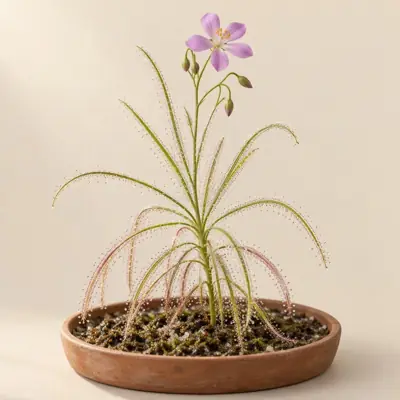
Few sources report a mature height of about 10–15 cm and a mature spread of about 0–50 cm. Its narrow, linear to almost threadlike leaves can become long; younger leaves are more upright and older leaves gradually droop, while stalked glands densely cover the leaf surface from base to tip and secrete mucilage that traps and digests insects. It is reported to bear solitary flowers with pale purple to pink-purple petals, lanceolate sepals, and yellow anthers shorter than the filaments; flowering is described as occurring from Australian summer into autumn, while a Chinese-language source also describes flowering and fruiting during the dry season. The fruit is reported to be a broadly ovoid, two-chambered capsule that gradually splits when mature and dry to release black seeds with a honeycomb-like surface texture.
Light
Byblis liniflora is reported to grow from more shaded conditions to strong light, and wild records also place it in sunny sites; full sun is given as its light need.
Watering
The growing medium is generally kept moist, and seedlings are reported to be better supplied with water from below rather than exposed directly to rain. Tray (bottom) watering is reported to be compatible, with the moisture target being to keep evenly moist.
Humidity and airflow
Few sources report a humidity range of about 60–95 %.
Temperature and dormancy
Sources differ on the reported hardiness zone. Few sources report temperatures from about 18 °C to about 35 °C. It is reported to be frost tender; keep above freezing.
Growing medium and mounting
A peat-and-sand growing medium is reported as suitable, while the wild habitat has poor, sandy soil.
Propagation
Propagation is reported to be by seed.
Common problems
Seedlings are reported to die readily when directly exposed to rain. The plant is sensitive to frost and should be protected from freezing, while seedlings also do not tolerate direct rain.
Identification
Byblis liniflora is carnivorous and low-growing, can form dense vegetation, has green to red ornamental coloration on its leaves, and bears pink flowers.
Photos


Sources
- Wikipedia (en): Byblis liniflora — CC BY-SA 4.0 · link
- 維基百科:亞麻花腺毛草 — CC BY-SA 4.0 · link
- Wikipedia (de): Byblis liniflora — CC BY-SA 4.0 · link
- Wikipedia (fr): Byblis liniflora — CC BY-SA 4.0 · link
- Wikipedia (es): Byblis liniflora — CC BY-SA 4.0 · link
- Top Tropicals catalog: Byblis liniflora — © Top Tropicals LLC (facts only) · link