
littleleaf boxwood (Buxus microphylla)
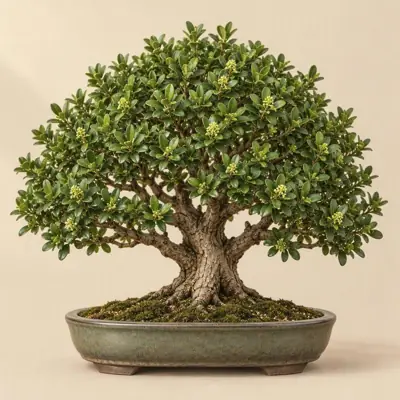
Buxus microphylla is an evergreen, slow-growing, much-branched shrub to small tree; horticultural forms are typically compact and rounded to spreading.
Overview
Buxus microphylla is an evergreen, slow-growing, much-branched shrub to small tree; horticultural forms are typically compact and rounded to spreading.
Origin and habitat
Buxus microphylla is mainly associated with Japan and Taiwan, and TaiCOL treats it as native to Taiwan; sources differ on the treatment of Japanese, Chinese, and Korean material, with some assigning the natural Japanese distribution mainly to var. japonica. Japanese accounts describe it in mountainous habitats, especially on limestone or serpentine terrain, while other sources describe locally distributed populations on drier slopes and also note widespread cultivation. It is suited to cultivation in temperate regions and can also be grown as an ornamental in cooler conditions.
Characteristics
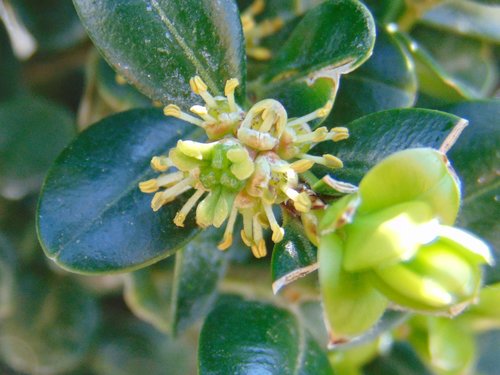
Sources differ on mature height, placing it at about 75–500 cm, while mature spread is 100–150 cm; growth is slow. The opposite, leathery leaves are green to dark green and commonly obovate, elliptic, or ovate, with rounded or slightly notched tips; sources differ in descriptions of leaf size, and the foliage may turn red, yellow-brown, orange, or bronze in winter or at low temperatures. The small, pale yellow to yellow-green flowers occur at branch tips or in leaf axils; the plant is monoecious, with a female flower in the center of an inflorescence surrounded by several male flowers, and flowering occurs in spring. The fruit is a capsule that may be ovate, elliptic, or obovate and splits open at maturity to release the seeds; Japanese sources describe it as maturing later in the year.
Light
It grows in full sun to partial sun or bright shade; RHS favors light shade, and full sun combined with dry soil may dull or scorch the foliage.
Watering
It prefers moist, cool, well-drained soil, and its relatively shallow roots can be mulched to retain moisture. Established plants generally have some drought tolerance, but strong sunlight in dry conditions may reduce foliage quality.
Temperature and dormancy
RHS reports a hardiness rating of H6.
Growing medium and mounting
It grows in fertile, well-drained soil and can adapt to chalk, clay, loam, and sand, across acidic, neutral, and alkaline conditions.
Propagation
Buxus microphylla can be propagated by seed, cuttings, or grafting, and stem cuttings root readily; RHS also describes semi-hardwood cuttings and grafting at different times of year.
Common problems
Reported pests include boxwood spider mites, boxwood psyllids, and oystershell scale. Dry soil combined with strong full sun may cause dull or scorched foliage, and some cultivars develop orange-brown leaves during winter or extreme weather. Some cultivars are reported to develop orange-brown foliage in wind, winter weather, or other extreme conditions, while late spring frost may damage new growth after pruning.
Identification
Buxus microphylla has small, opposite, leathery leaves with commonly rounded or slightly notched tips, often forms a compact evergreen crown, and may have young twigs that are nearly four-angled. Compared with Buxus sempervirens, some sources distinguish it by more conspicuous petioles, leaves lacking a strong odor, and, in some varieties, leaf margins that do not roll downward.
Photos


Sources
- Wikipedia (en): Buxus microphylla — CC BY-SA 4.0 · link
- Wikipedia (ja): ツゲ — CC BY-SA 4.0 · link
- Wikipedia (de): Kleinblättriger Buchsbaum — CC BY-SA 4.0 · link
- Wikipedia (es): Buxus microphylla — CC BY-SA 4.0 · link
- GBIF descriptions: The Woody Plants of Korea (한국의 수목); Lista de especies de plantas exóticas y trasplantadas de Colombi — per dataset · link
- NC State Plant Toolbox: Buxus microphylla — copyright (facts only) · link
- TaiCOL 臺灣物種名錄: Buxus microphylla — CC BY 4.0 · link
- Useful Tropical/Temperate Plants: Buxus microphylla — CC BY-NC-SA 3.0 (facts only) · link
- RHS Plants: Buxus microphylla — © RHS, facts only · link