
South American Jelly Palm (Butia odorata)
Butia odorata is an evergreen, single-trunked palm with a stout, upright to slightly leaning trunk and a crown of pinnate leaves. It is generally described as a perennial evergreen woody palm.
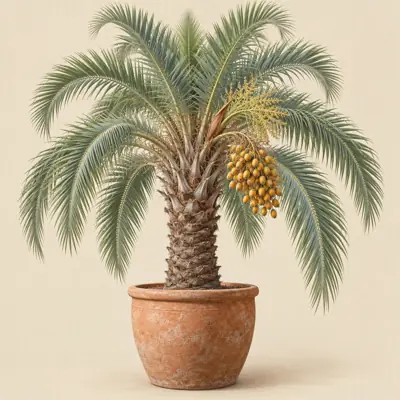
Overview
Butia odorata is an evergreen, single-trunked palm with a stout, upright to slightly leaning trunk and a crown of pinnate leaves. It is generally described as a perennial evergreen woody palm.
Origin and habitat
It is native to southern South America, including southern Brazil, particularly Rio Grande do Sul, and Uruguay. Its habitats include grasslands, open areas, and sandy savannas near the coast; in Uruguay it also occurs in grasslands, poorly drained plains, sandy and rocky areas, coastal environments, and along lagoons, with extensive palm-dominated stands in some areas. It is native to warm-temperate to subtropical environments and tolerates some frost, drought, and coastal salt spray, but is not suited to hot, humid lowland tropical environments.
Characteristics
Sources differ on mature height, placing it at about 200–1000 cm, and its growth is slow. The pinnate leaves range from blue-green and gray-green to dark green and are long and arching downward or recurved; the petiole margins bear stiff fibers and spines, and the leaflets are arranged along the rachis in a pronounced V shape. Sources differ in their descriptions of the flowers: the inflorescence is protected by a woody spathe and has primary branching, while flower colors may include yellow, cream, red-orange, purple, yellow-purple, or greenish yellow; the flowers can attract bees. Flowering is reported in late spring in the Southern Hemisphere; the drupes are typically wider than long and may become yellow, orange, red, greenish yellow, or purple when mature, with juicy, aromatic flesh that is usually sweet-tart and a usually nearly spherical stone containing seeds, and they mature from late summer to early autumn in the Southern Hemisphere.
Light
It prefers a warm position with abundant sunlight and can also accept light or partial shade; in shade the leaves become longer and the silvery-gray coloration may weaken, while full shade is not tolerated.
Watering
Ample water during active growth can promote growth, but the soil should drain well; established plants tolerate drought and drier winter conditions but not prolonged wet soil.
Temperature and dormancy
Sources differ, but the reported minimum temperature is about -10 °C.
Growing medium and mounting
It adapts to various fertile, moist but well-drained soils and prefers loose, sandy, well-drained soil that is neutral to slightly alkaline.
Feeding
Fertilizing during active growth can increase the growth rate, and palm-specific fertilizer can be used in nutrient-poor soil.
Common problems
It is reported to have few pest problems. Full shade, prolonged low temperatures, or persistently wet soil are reported to cause cultivation problems. It tolerates some frost, brief low temperatures, drought, salt spray, and some saline or alkaline conditions, but is not suited to hot, humid lowland tropical climates; young plants are less cold-tolerant than older plants.
Identification
Distinguishing features include a single stout trunk, long recurved pinnate leaves with V-shaped leaflets, spines at the petiole base or margins, and aromatic fruit.
Photos


Sources
- Wikipedia (en): Butia odorata — CC BY-SA 4.0 · link
- Wikipedia (fr): Butia odorata — CC BY-SA 4.0 · link
- Wikipedia (es): Butia odorata — CC BY-SA 4.0 · link
- NC State Plant Toolbox: Butia odorata — copyright (facts only) · link
- Useful Tropical/Temperate Plants: Butia odorata — CC BY-NC-SA 3.0 (facts only) · link