Bulbophyllum rothschildianum (Bulbophyllum rothschildianum)
Bulbophyllum rothschildianum is reported to be an epiphytic orchid. It is reported to be an evergreen perennial.
Overview
Bulbophyllum rothschildianum is reported to be an epiphytic orchid. It is reported to be an evergreen perennial.
Origin and habitat
Sources differ on the more specific native range in Asia, with records including northeastern India, Assam, Darjeeling, southern Yunnan in China, and Myanmar. It is reported to grow epiphytically on tree trunks in temperate cloud forests. Its reported environment is temperate cloud forest.
Characteristics
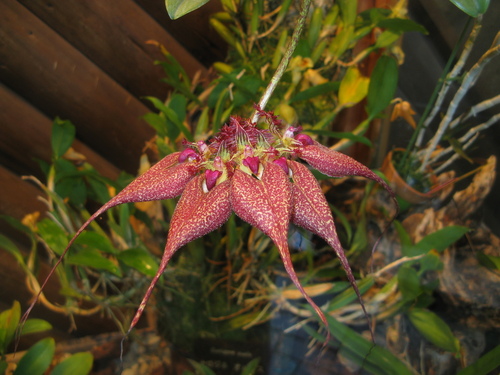
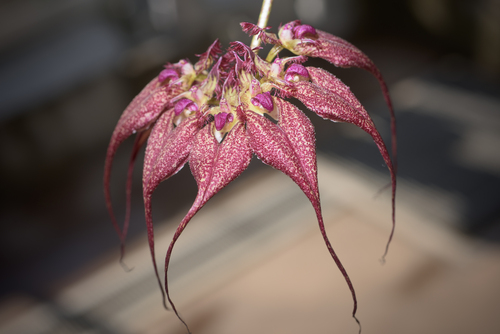
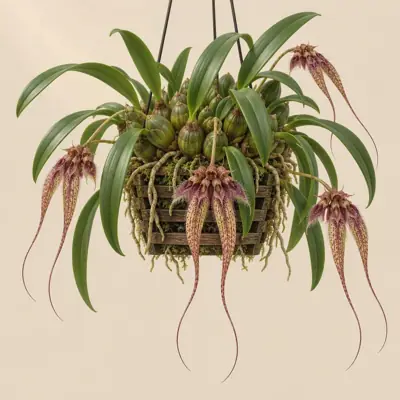
Leaves arise from the tops of ovoid pseudobulbs and are narrowly linear and leathery. The upright inflorescences are reported to arise from the bases of the pseudobulbs, with flowers arranged in a whorl at the tip. The flowers are yellow-green with extensive reddish-purple spots and stripes, giving an overall purplish-red appearance; the dorsal sepal and lateral petals are relatively small and nearly triangular with fringed appendages, while the lateral sepals extend forward, are fused in their middle portions, and end in slender, whip-like, densely hairy tips; the lip is small, fleshy, tongue-shaped to triangular, and pink to reddish-purple, and another source describes the flowers as fragrant. Sources differ on flowering season, describing flowering in autumn or in both spring and autumn.
Light
It is reported to grow in partial shade. Specialist information generally recommends medium light.
Watering
During cultivation, it is reported to need ample water together with a fast-draining medium. Specialist information generally recommends keeping it slightly dry.
Temperature and dormancy
Specialist information generally describes Bulbophyllum rothschildianum as warm-growing.
Growing medium and mounting
It is reported to require a fast-draining growing medium and can be grown in a pot or basket. Specialist information generally indicates a preference for sphagnum moss.
Feeding
It is reported to require adequate fertilizer during cultivation.
Common problems
Cultivation is reported to require a balance of ample water, fast drainage, and good air circulation.
Identification
The most conspicuous reported feature is the fusion of the lateral sepals in their middle portions and their strong elongation into slender, whip-like tips. The flowers are arranged in whorled or umbel-like clusters, and the small perianth segments bear fringed appendages that can move in the wind.
Photos